Hello
Your whole product, translated automatically.
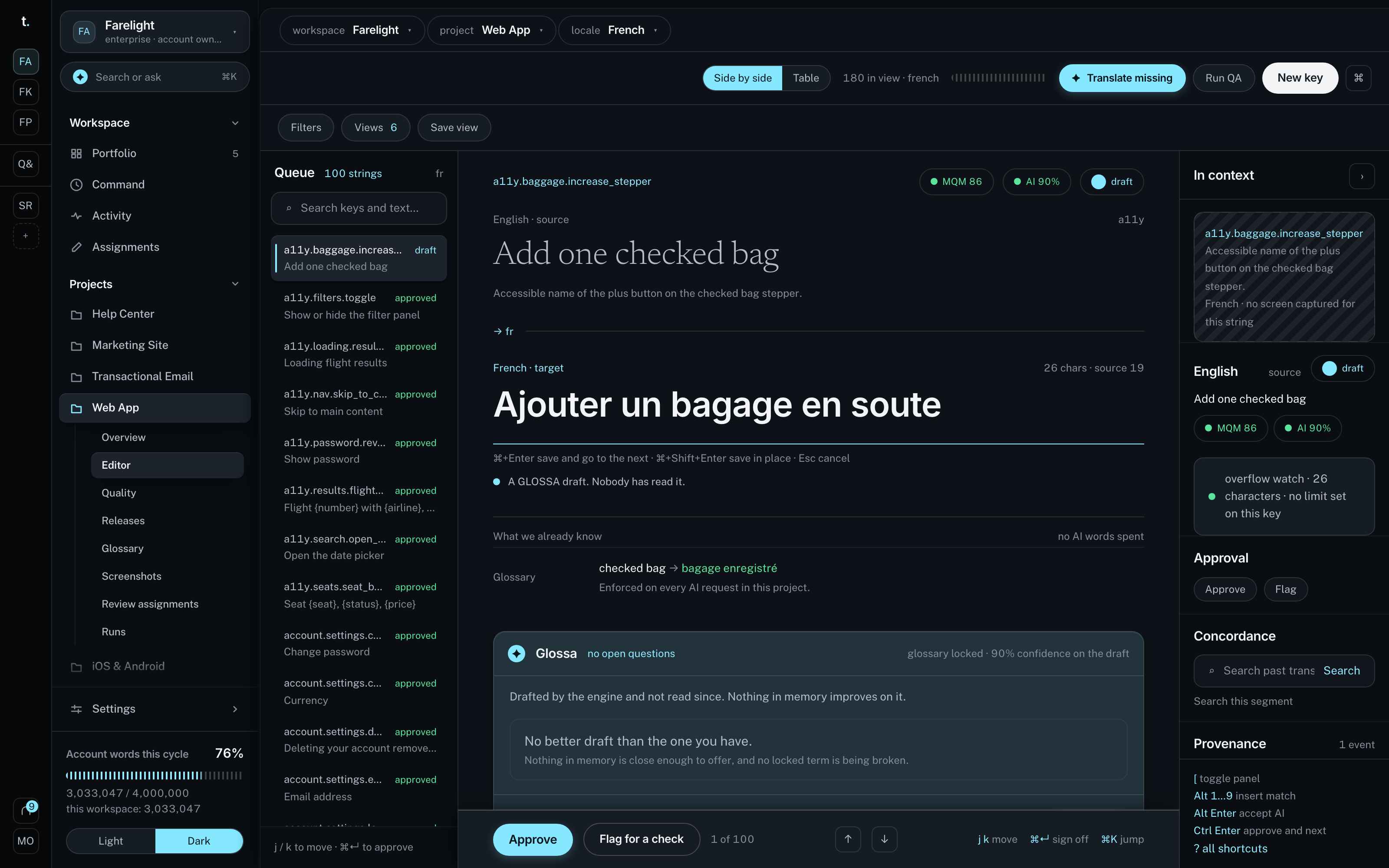
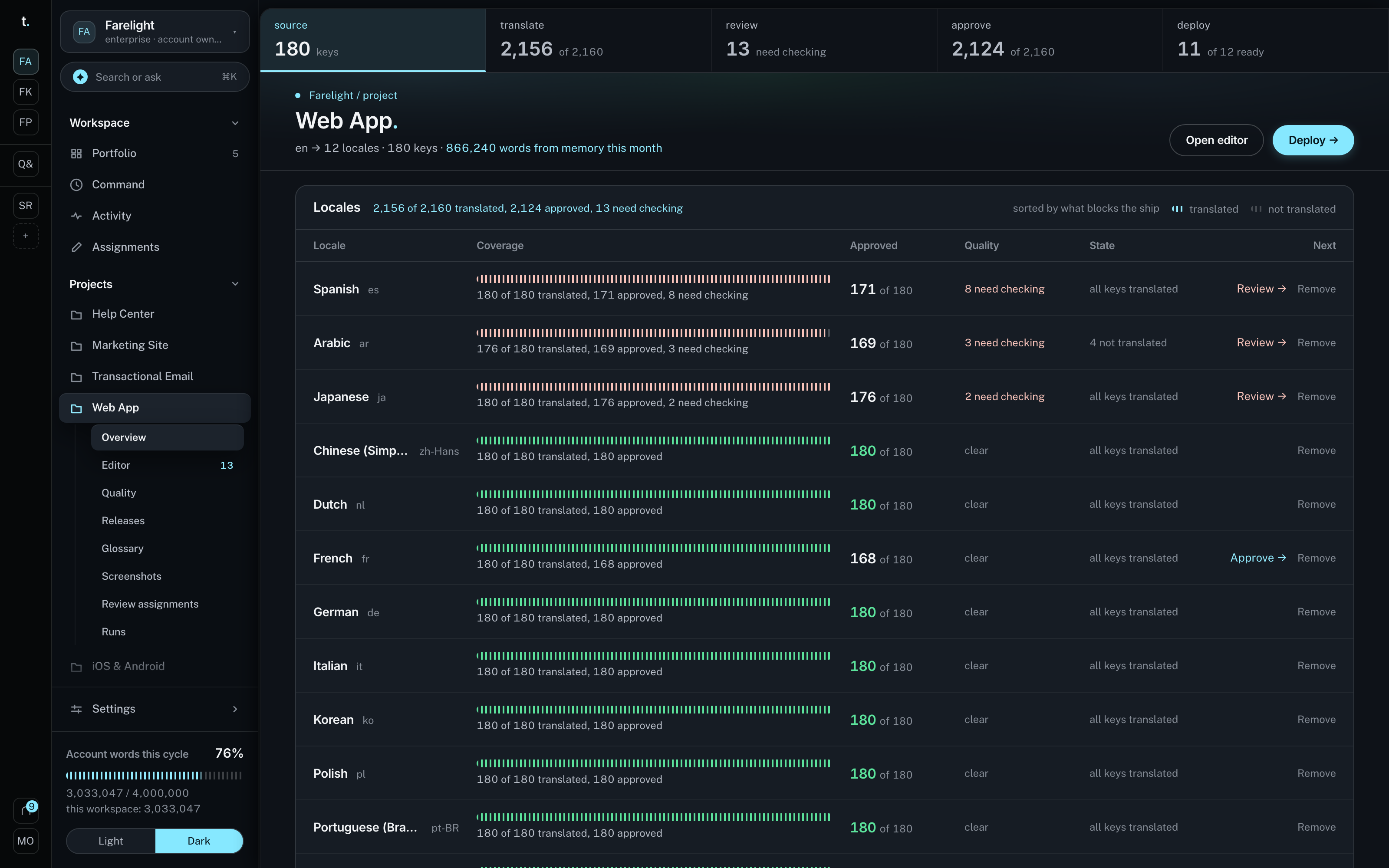
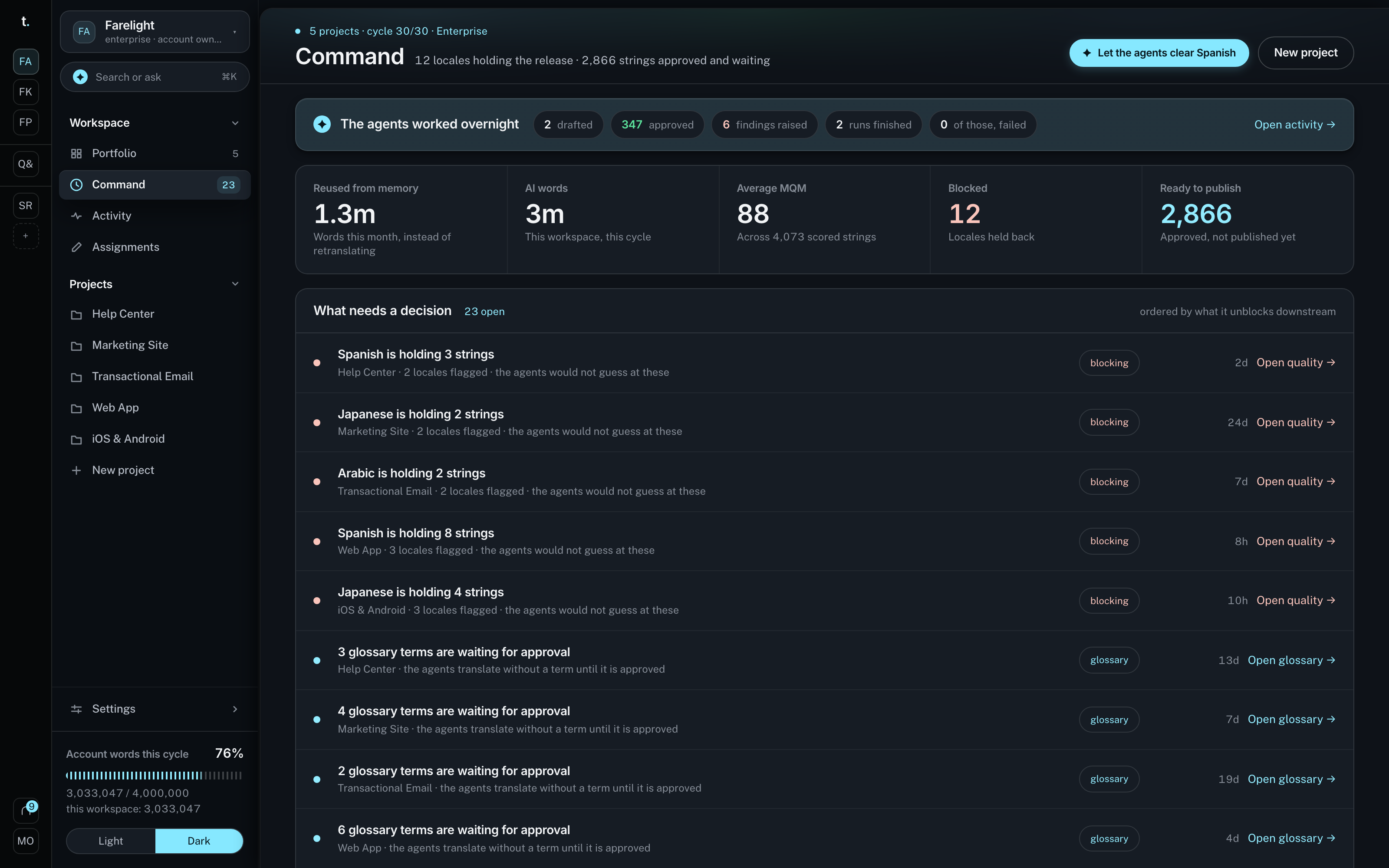


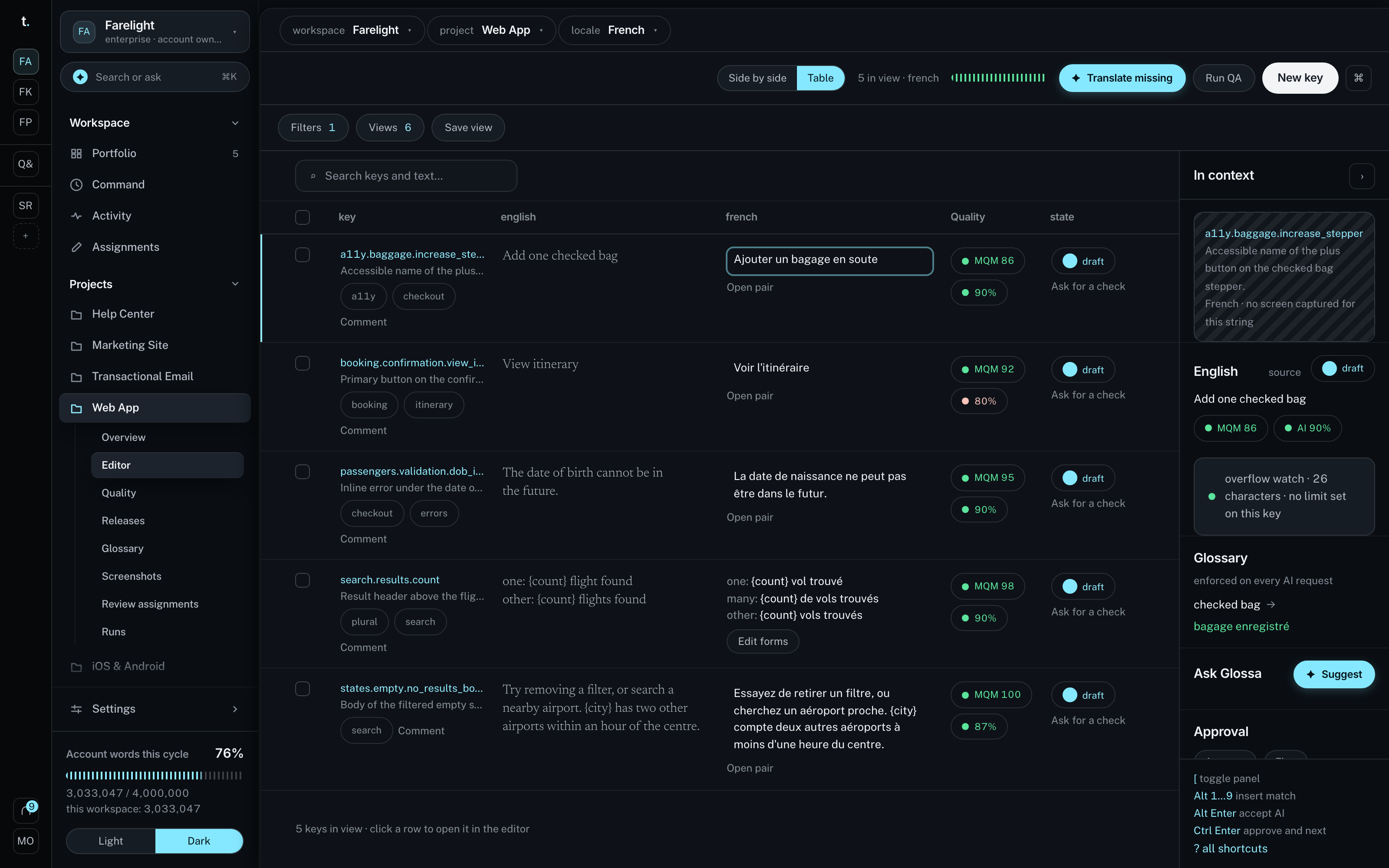
Your product, in every language you sell in. Edited on the page itself.
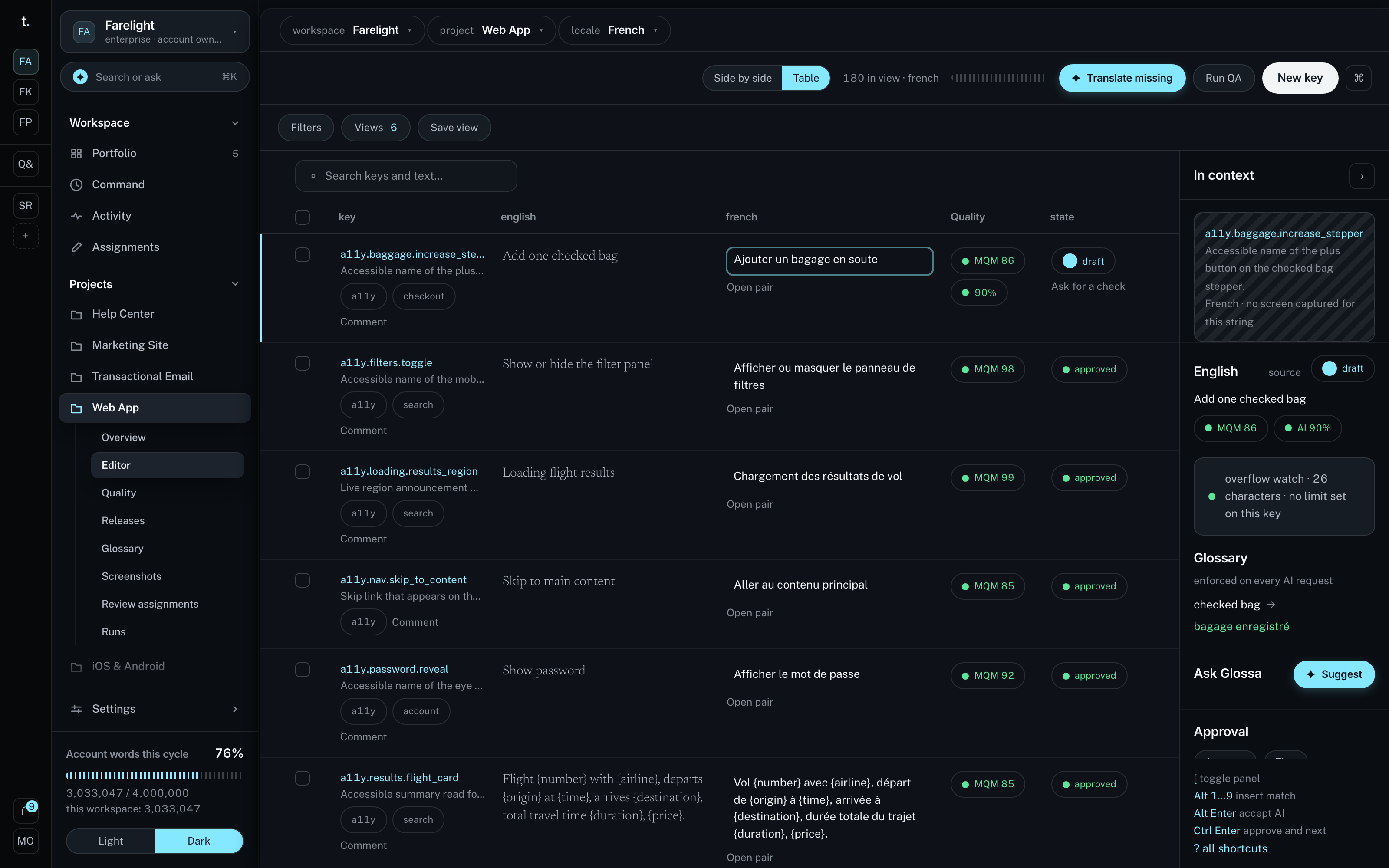
A real checkout, running below in the language you pick. Change any word on it and the fix is live, reviewed and versioned, without a release.
product names come from the catalog, not the string file. The overlay leaves them alone.
save a string and it lands here, and in the project as a new version
We make it easy to sell to customerswho do not speak your language.
Every string, every language, on the same push.
Connect a repository or a CMS. Transglot finds the strings, drafts every locale you have configured in parallel, and writes them back as a pull request or straight into your CMS.
One place your whole team can work, not one engineer.
Every string, every language, who changed what and when. Four roles, per project and per language, on every plan including Free.
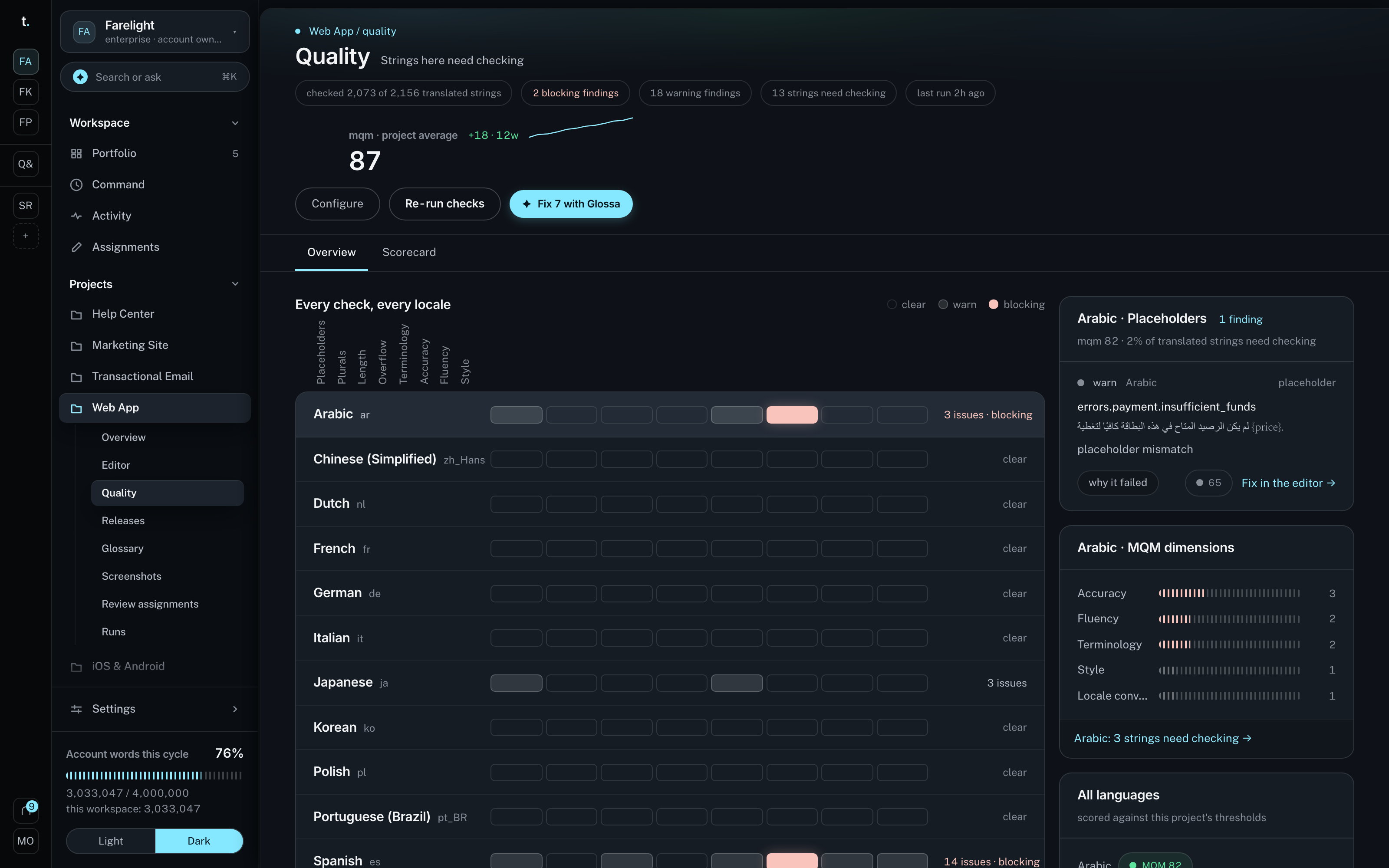
Four checks on every row, before anyone reads it.
Placeholders, plurals, glossary and length are checked on every translation. A row that fails is repaired once, and if it still fails it is refused rather than shipped.
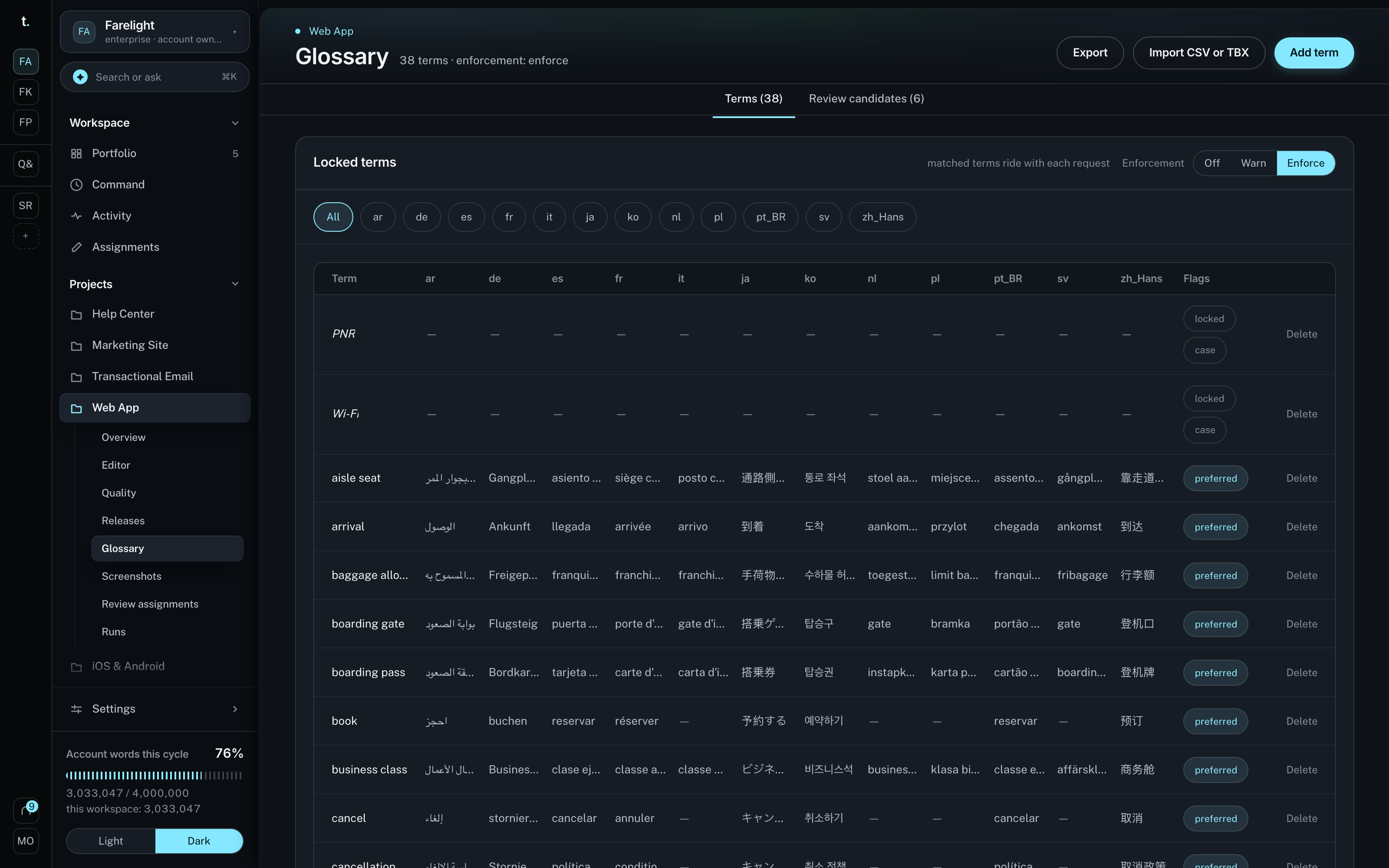
The words your brand lives on are never rewritten.
Load the terms that must stay put and the ones that must never appear. They are locked into the prompt, and then checked again afterwards.
It runs inside the pipeline you already have.
A missing translation fails the pull request rather than the launch. There is a CLI, a GitHub Action, a REST API, signed webhooks and an MCP server your own agents can call.
Fix a typo in Japanese without shipping a release.
Translations publish to an edge bundle your app pulls over the air. A correction is live inside the minute, with no app store review and no redeploy.

Two AI models. One fast, one careful.
Glossa Flux drafts every language the moment your English changes. Glossa Deep takes the slow route on the strings your brand is judged on.
| What happens | Glossa Fluxdrafts everything, always on | Glossa Deepthe careful pass, where it counts | Agencies and TMSthe old way |
|---|---|---|---|
| What it is for | The whole locale set, drafted the moment the English changes. | The strings a customer judges you on: the pricing page, the checkout, the error a payment throws. | Whatever you remembered to put in the file you sent. |
| Why it is fast | Every configured locale runs at the same time, not one after another, and a sentence you have already approved is reused rather than re-written. | Slower on purpose: several steps per string, and it can look at a screenshot of where the string renders. | One round trip per release, per language, in business hours. |
| What it is told first | Your glossary, your do-not-translate list and the plural rules for the language, before it writes anything. | All of that, plus the surrounding screen, the key name and the length the interface can hold. | A spreadsheet, and a style guide nobody opened. |
| On a failure | Repaired once, re-checked, and refused if it still fails. A broken row does not ship. | Escalated to a human with the rendered screen attached, so the reviewer can see the problem. | Found by your users. |
| What it costs | Included on every plan, Free included. Unchanged strings cost nothing to re-run. | Included from the Team plan. No per-word surcharge for using it. | Quoted per word, per language, per round. |
- What it is for
- The whole locale set, drafted the moment the English changes.
- Why it is fast
- Every configured locale runs at the same time, not one after another, and a sentence you have already approved is reused rather than re-written.
- What it is told first
- Your glossary, your do-not-translate list and the plural rules for the language, before it writes anything.
- On a failure
- Repaired once, re-checked, and refused if it still fails. A broken row does not ship.
- What it costs
- Included on every plan, Free included. Unchanged strings cost nothing to re-run.
- What it is for
- The strings a customer judges you on: the pricing page, the checkout, the error a payment throws.
- Why it is fast
- Slower on purpose: several steps per string, and it can look at a screenshot of where the string renders.
- What it is told first
- All of that, plus the surrounding screen, the key name and the length the interface can hold.
- On a failure
- Escalated to a human with the rendered screen attached, so the reviewer can see the problem.
- What it costs
- Included from the Team plan. No per-word surcharge for using it.
- What it is for
- Whatever you remembered to put in the file you sent.
- Why it is fast
- One round trip per release, per language, in business hours.
- What it is told first
- A spreadsheet, and a style guide nobody opened.
- On a failure
- Found by your users.
- What it costs
- Quoted per word, per language, per round.
The seven things that decide it.
It refuses.
Everyone else flags a bad translation and ships it anyway. Placeholders, plurals, glossary and length are checked before a model is asked for an opinion. A row that fails is repaired once, re-checked, and then held rather than published.


A sentence you settled costs nothing again.
An exact match is served from your memory instead of being re-written, and it is never metered.
In and back out, intact.
JSON, XLIFF, PO, Android XML, iOS strings and stringsdict, ARB, YAML and the rest, with plurals and placeholders held both ways.
32 of them two way.
Your CMS, your repository, your help desk, your design tool. Every connector is included rather than sold as an add-on.
Six forms in Arabic, one in Japanese.
Every CLDR plural category for the language, held as a set. A missing form is a failed gate, not a shipped bug.
- zero
- one
- two
- few
- many
- other
Tools your agents can call.
Read a project, add a language, translate what is missing, run the checks. An agent cannot ship a broken string either.
Fix the wording on the running page, not in a spreadsheet.
The overlay draws in a shadow root so your CSS is untouched, the key in the page cannot write, and every change carries the name of the person who made it.
- German breaks the button
- the screenshot is kept with the string
- per reviewer attribution
- no ticket, no deploy
Read it before you buy it. Nothing is gated.
- The Boring Localization Booklong formThe Boring Localization Bookbeing writtenlong formbeing written
The Boring Localization Book
The argument in full: why language should ship on the same rails as code, and what changes in a team when it does.
read the outlinein preparation - A First Multi-Locale Launchlong formA First Multi-Locale Launchbeing writtenlong formbeing written
A First Multi-Locale Launch
Sequencing, right-to-left, pricing pages and support load, in the order a first launch actually meets them.
read the outlinein preparation - The Locale ReferencereferenceThe Locale Reference708 ICU localesreference708 ICU locales
The Locale Reference
Every locale the validator accepts, how a tag is canonicalised, and which languages carry their own plural rule set.
open the referencelive page - The Cost ModelmodelThe Cost Modelyour numbersmodelyour numbers
The Cost Model
The calculator with its assumptions visible and editable, so you can disagree with ours and still get a ledger out.
open the calculatorlive page - The LexiconspecimenThe Lexiconone pagespecimenone page
The Lexicon
The whole product set as a dictionary entry: senses, a conjugation table, specimen plates and attested figures.
read the entrylive page - The DispatchdispatchThe Dispatchpublished as writtendispatchpublished as written
The Dispatch
Shorter than a book: pieces on i18n setup, glossary enforcement, QA in CI, and migrating off another tool.
read the dispatchlive page
FAQs
What people ask before they connect anything.