diff
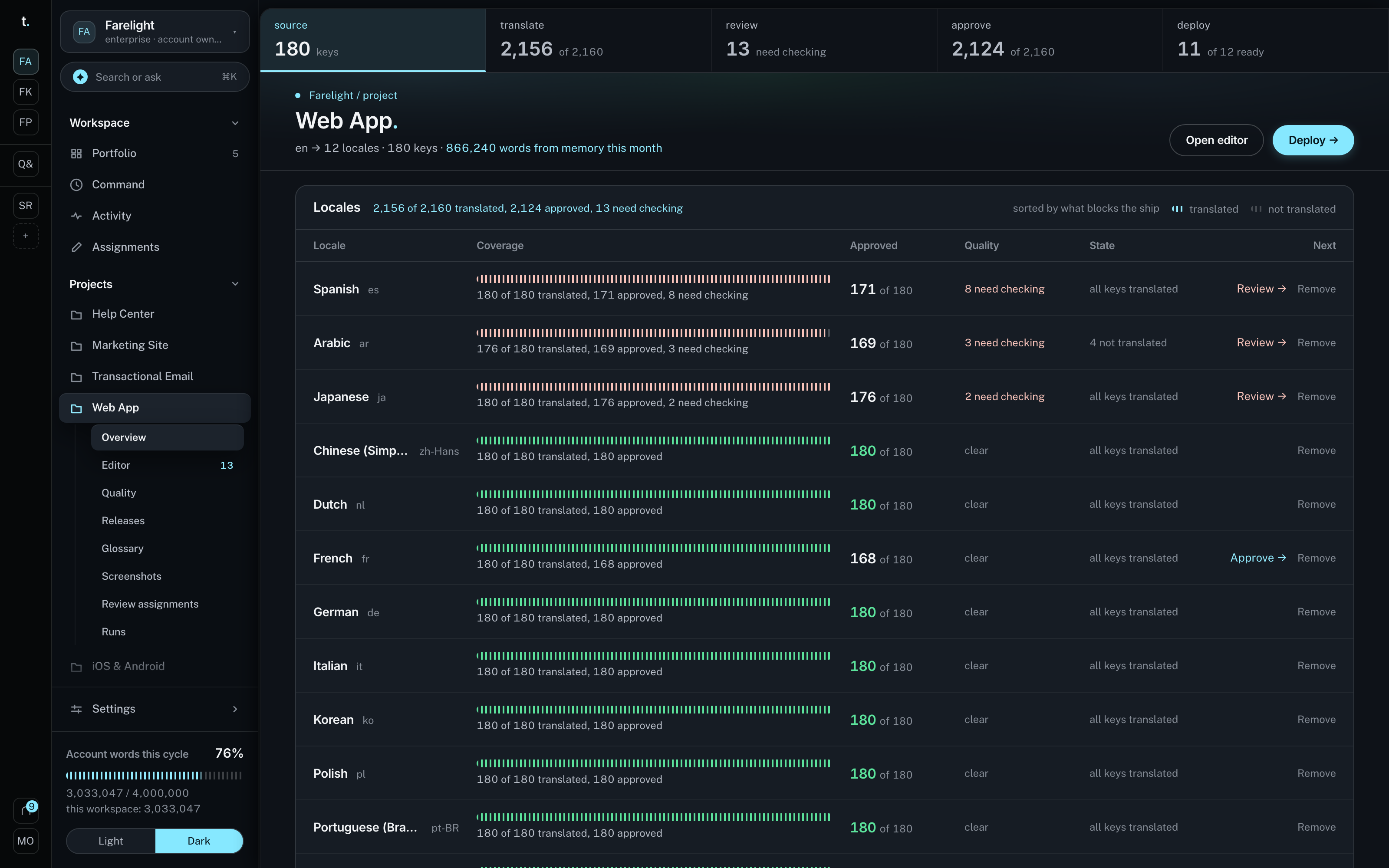
AI translation that writes every language, and it refuses to ship a broken one.
Every string goes through Glossa Flux, the fast pass, the moment the English changes. The ones your brand lives on go through Glossa Deep, the careful one. Both end at the same four checks, where a row passes, is repaired once, or is held.
All of it, on one screen.
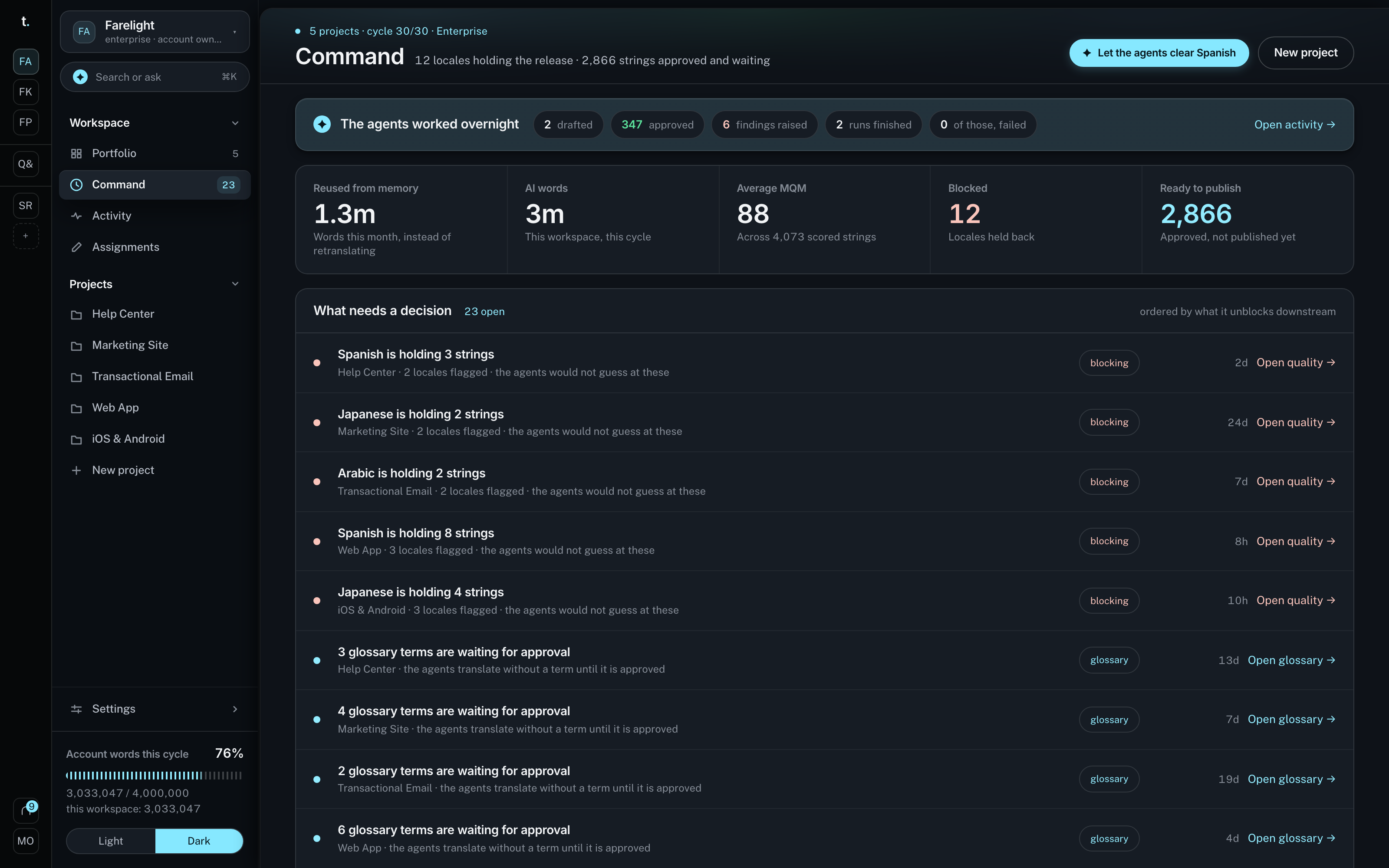
The strings your brand lives on, minded.
Turn quality mode on for a project, or for just the locales that carry money or law. Everything else stays on the fast pass, where it belongs.
- You pick the scope
- The whole project, or only the locales that carry money or law. Everything else keeps the fast pass.
- Reviewed in the real screen
- Re-rendered at real size, in place, so tone, fit and glossary are checked where a reader meets them.
- Escalates with evidence
- A refusal reaches a human with the rendered screen and the failing gate attached. Approve or fix in one step.
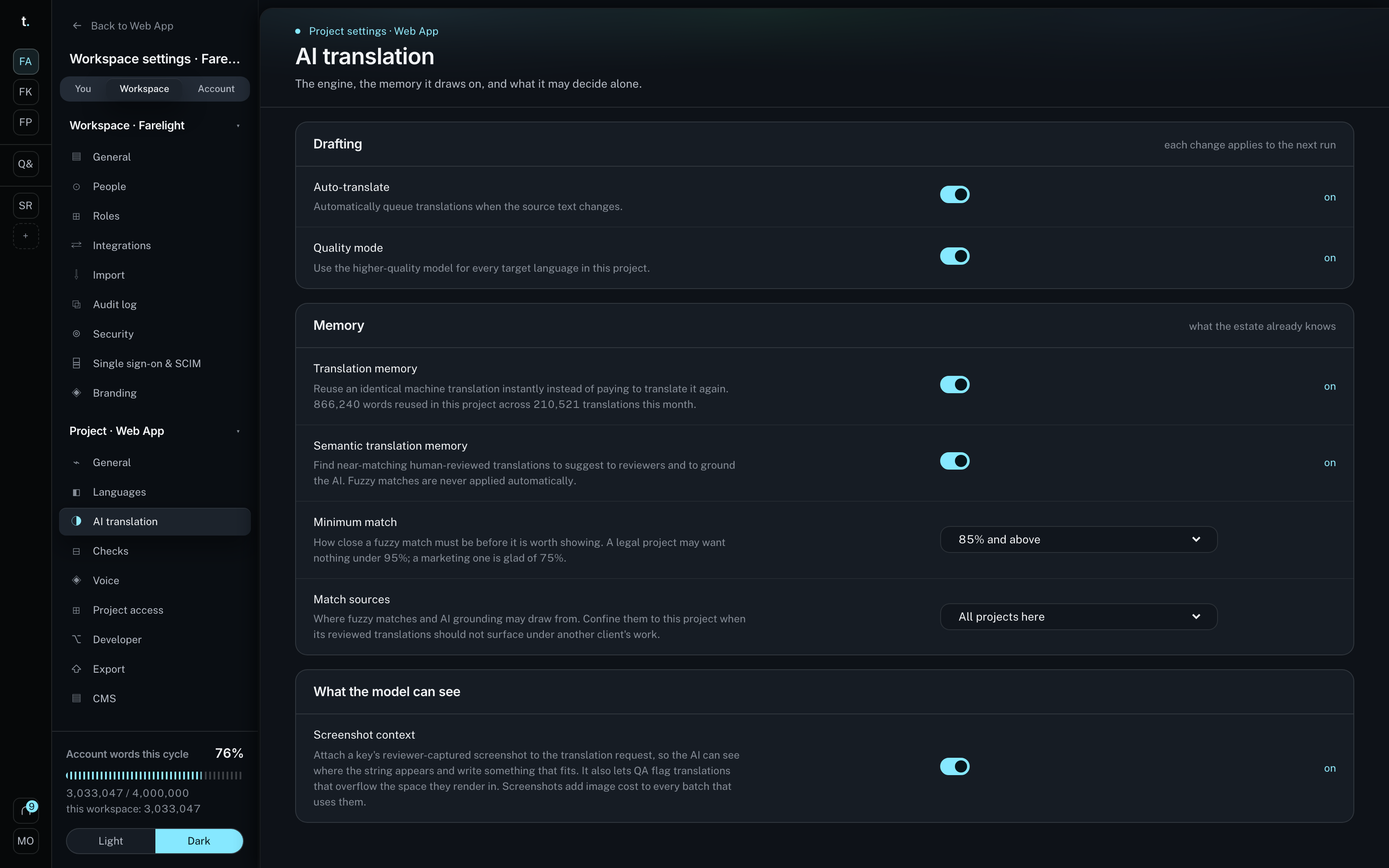
Four gates. Every row, every commit.
Whichever pass drafted it, no row ships without clearing all four. A failure gets one automatic repair, and is refused if that does not fix it.
Placeholders
Every variable survives the trip: never dropped, never reordered into nonsense.
en Hi, {name}!
ja {name}さん、こんにちは
Plurals
All the categories a language needs. Russian takes four, Arabic takes six, and the rule set comes from CLDR rather than from a guess.
ru файл
ru файл / файла / файлов
Glossary
Locked terms and forbidden terms are enforced, not suggested, in every locale.
term "Transglot", do not translate
held in every mapped locale
Length
German is long and buttons are small. Rows are measured against the component budget, not a character count.
de In den Einkaufswagen legen
de In den Warenkorb
- gate 1 placeholder {code} missing from the draft
- repair reinserting {code} and re-shaping for right to left
- re-run all four gates, on the repaired row
- pass row released, nothing filed and nothing waiting
What the pipeline actually does.
One command, any repository
The CLI reads your format, pushes the diff and streams the run back by locale.
file formats
JSON, YAML, .strings, .stringsdict, ARB, .po, XLIFF 1.2 and 2.0, RESX, properties and more. Seven of them carry plurals.
Memory before generation
Translation memory and locked glossary terms are bound before a draft is written, so a term you settled last year outranks anything the model prefers today.
- translation memory
- glossary locks
- style rules
Context, not just text
Where a screenshot exists, the draft sees the component the string ships in, along with its length budget.
- rendered screen
- length budget
- key history
Every locale ICU knows
No fixed list to run out of.
- fr-FR
- ja-JP
- ar-EG
- pt-BR
- ko-KR
- de-CH
- hi-IN
- nb-NO
- tr-TR
- uk-UA
Your agents speak Transglot
Sixteen MCP tools, the same verbs and the same gates as everything else.
Refusal is a feature
A row that cannot be repaired is held with its failing gate and its rendered screen, and the branch check stays red. The alternative is a broken string that nobody sees until a customer does.
FAQs
The questions teams ask before they let it write.
Does every string really go through the fast pass?
When should a project go on the careful pass?
What happens when a row fails a gate?
Which languages can it draft?
Which formats and frameworks does it read?
Do you train on my content?
41 connectors, already built.

































Watch it run on your own strings.
No card and no sales call. Put your strings in and the first run drafts, gates and repairs itself while you watch.