Automated translation QA for every string
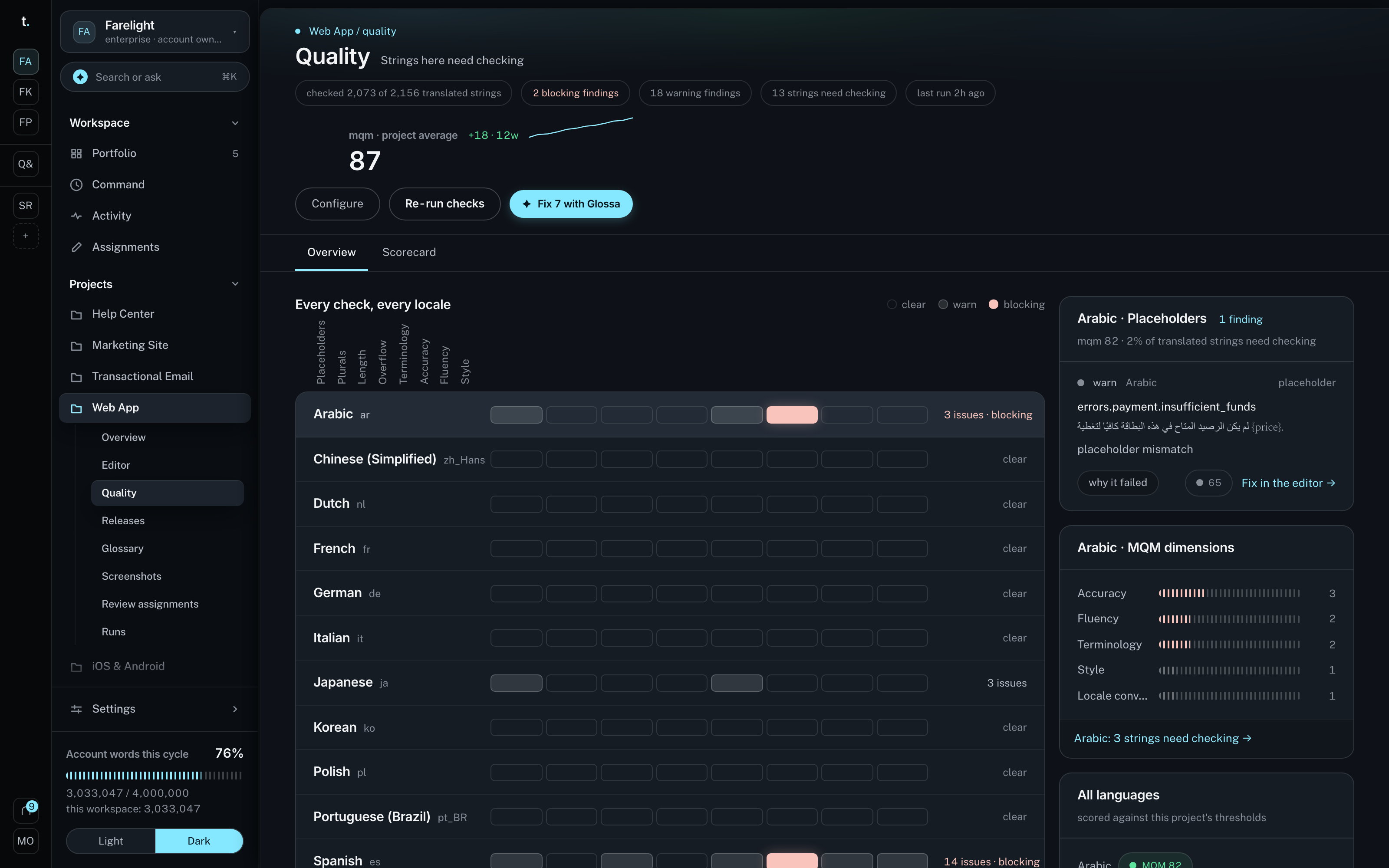
A quality pass that combines free deterministic checks — placeholders, plural categories, length, terminology — with an MQM-style AI review that scores each translation and flags what needs a human. Optional self-heal suggests or applies a validated fix, and never overwrites a human edit.
A quality pass that spends AI only where it counts
Before spending a single AI call, every row is checked for placeholder integrity (per plural form too), complete CLDR plural categories, max-length, and glossary terminology. A structurally broken row is flagged instantly, at no cost.
Rows that pass the deterministic gate get a batched Claude review (Sonnet 5) that returns a 0–100 quality score plus findings categorized as accuracy, fluency, terminology, style, placeholder, plural, or length — each with a severity and a short message.

A row is flagged for human review when any finding is major-or-worse, or when the AI score falls below the threshold of 70. Findings persist on the row and surface in the editor, so reviewers see exactly what to fix.
Self-heal has three modes: off, suggest (the default), and apply. Suggest attaches a validated fix for a human to accept; apply re-translates the failing machine row and writes a validated, version-snapshotted correction. A human-edited or reviewed row is never touched — human always wins.
Translation QA, self-heal, and style inference are available on the Team plan and up, alongside Quality Mode.
What translation QA gives you
- Deterministic checks, free — before spending a single AI call, every row is checked for placeholder integrity, complete CLDR plural categories, max-length, and glossary terminology.
- MQM-style AI review — rows that pass the deterministic gate get a Claude review that returns a 0–100 quality score plus findings categorized as accuracy, fluency, terminology, style, placeholder, plural, or length, each with a severity and a short message.
- Placeholder & consistency validation — placeholder tokens are compared between source and target (per plural form too), so a mismatched or dropped variable is caught deterministically before it ships.
- Needs-review flagging — a row is flagged when any finding is major-or-worse, or when the AI score falls below the threshold. Findings persist on the row and surface in the editor.
- Confidence-gated auto-approve — at translate time the structured-output agent self-reports a per-string confidence, and only structurally-clean, high-confidence rows auto-approve; anything uncertain routes to a human. The deterministic validator and QA pre-gate always win, so a confident-but-broken row still goes to review — reviewers see the risky strings, not all of them.
- Per-language MQM scorecard — a per-locale scorecard (score trend, top finding categories, and share of rows needing review) you can export as CSV: a procurement- and renewal-ready quality artifact, built from indexed reads at no extra AI spend.
- Guarded self-heal — choose per project: suggest attaches a validated fix for a human to accept; apply re-translates the failing machine row and writes a validated, version-snapshotted correction. A human-edited or reviewed row is never touched.
- Incremental & metered — re-running QA over an unchanged project does zero AI work; a row is only re-checked when its source moved or its translation changed. Runs are quota-metered per organization and scoped to missing, stale, selected, or all.
- Style inference — from your human-reviewed translations, transglot can infer a draft style guide (formality, tone, brand voice, and do/don’t rules) for a human to edit. It is never applied automatically.
How a QA run scores your project
- Deterministic pre-gate, free — each row is first checked, with no AI call, for placeholder integrity (per plural form too), complete CLDR plural categories, max-length, and glossary terminology.
- AI semantic review — rows that pass the gate get a batched Claude review (Sonnet 5) that returns a 0–100 score and findings, each with a category, severity, and short message.
- Flag what needs a human — a row is marked needs-review when any finding is major-or-worse or the score falls below the threshold (70). Findings persist on the row and surface in the editor.
- Optionally self-heal — depending on the project’s mode, a flagged machine row gets a validated fix attached for a human to accept (suggest) or a validated, version-snapshotted correction written (apply). Never over a human edit.
Run QA over exactly the rows you mean
A run takes the same scope shape as a translation batch, so you can score a whole project or just what changed — and re-runs stay cheap.
- missing — score only rows that have never been QA’d: the first pass over a fresh project.
- stale — re-score only rows whose source moved since they were last checked.
- selected — score a specific set of keys or locales, useful for a targeted spot-check.
- all — score every eligible row: the full sweep, still incremental under the hood.
Compared with a manual spot-check
- Coverage — reviewers eyeball a sample and hope the rest is fine; or every target row is checked deterministically and every eligible row is AI-scored.
- Broken placeholders — a dropped {count} is found in production, if at all; or it is caught deterministically before the AI pass, for free.
- Cost of re-checking — re-reviewing the whole project from scratch every release; or an incremental run where a row is only re-checked when its source or translation changed.
- Fixing issues — manually rewrite each flagged string and hope you didn’t break another; or let guarded self-heal suggest or apply a validated, version-snapshotted fix.
- Protecting human work — a bulk “fix” script can clobber a carefully reviewed string; here a human-edited or reviewed row is never overwritten.
The guarantees behind the QA pipeline
QA is designed to be safe to run often: incremental, metered, and constitutionally unable to overwrite a human edit.
- Incremental by source hash — a row is skipped on re-run when its source hash still matches and it hasn’t changed since the last check, so re-running over an unchanged project does zero AI work.
- Scoped runs — target missing (never-QA’d), stale (source moved), a specific selection, or all: the same scope shape as translation batches.
- Metered per organization — the AI review meters once per chunk against your plan’s word limit, with a quota fail-fast before dispatch and a guard so a retried chunk never re-scores an already-scored row.
- Self-heal is compare-and-swap safe — apply mode re-translates only a machine row, gates the result through every deterministic validator, and writes under a row lock that re-asserts the row is still machine-translated. A human edit mid-run wins.
- Style inference stays a draft — from human-reviewed translations, QA can infer a draft style guide (formality, tone, brand voice, do/don’t) for a human to edit and save. It is never applied automatically.
Why use transglot for localization?
Tools and outcomes
- Translate with Claude, guided by per-project style guides and brand voice
- Edit copy on top of your live app with the in-context editor and vision-grounded suggestions
- Enforce terminology with a glossary, including AI candidate extraction and import/export
- Flag mistranslations, terminology violations, and placeholder errors with Quality Mode
- Drive every step from CI — or from an AI agent — with the CLI, GitHub Action, REST API, MCP server, and signed webhooks
Keep exploring
Every part of transglot operates on the same projects and keys, so the next piece picks up exactly where this one leaves off.
Glossary & Terminology
Terminology enforcement is one of the deterministic QA checks.
AI Translation
The Claude models behind translation and the QA review pass.
For localization managers
Keep quality high across translators with AI-assisted review.
Frequently asked questions
What the deterministic pass and the AI review each check, whether QA ever writes for you, what a re-run costs, and which plans include it.
A free deterministic pass checks placeholder integrity, complete plural categories, max-length, and glossary terminology. Rows that pass then get an MQM-style Claude review that scores each translation and returns categorized findings.