trans·glot
This page is the whole product written as a dictionary entry: what Transglot means, how it is used, and the figures behind it. In plain words, it translates every string in your app into every language you ship, checks the result, and fails the build when a translation is wrong.
| tranz-glot |
to make languages boring
Push once. Every locale in the run comes back as a pull request: drafted, checked against four gates, and merged only if it passes.
- 100,000 words to start on the free plan, 75,000 of them after a phone check
- no card to start
- four gates on every row
Plate II
the run, as it appears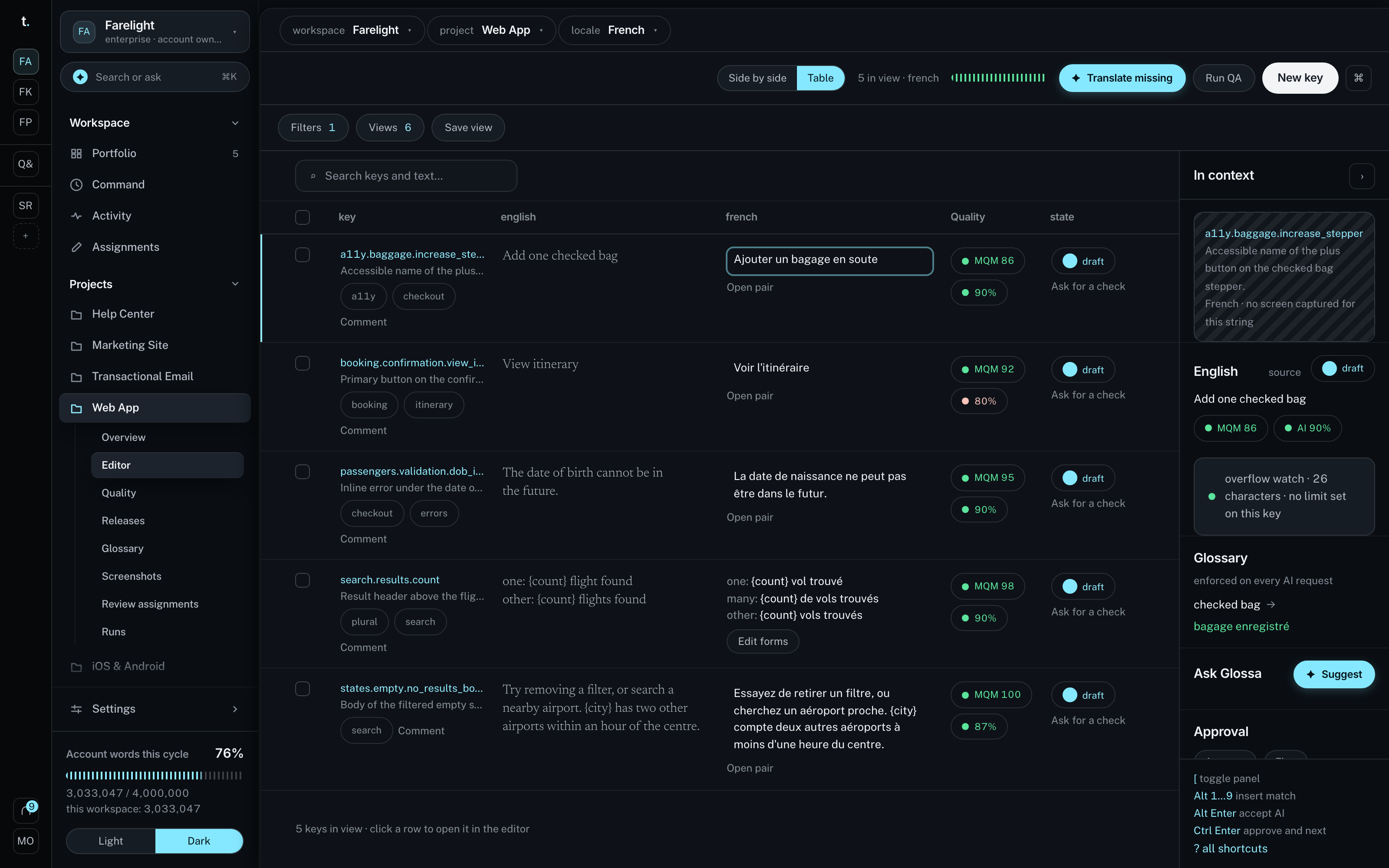
Definitions
A localization pipeline that lives in the repository: push a string, and every locale in the run comes back through four automatic quality checks.
To ship a feature in every locale a project carries, without a spreadsheet, an agency queue, or a meeting about copy.
Of localization: invisible when green, loud when red. The highest compliment infrastructure can earn.
The refusal that saves you. Placeholder integrity, plural completeness, glossary terminology and maximum length are checked on every row; a failing row is repaired on one corrective retry, or it is blocked. Source: QaRunner::preGate().
A monthly price with a word allowance, rather than an invoice per word. Team is $49 a month with unlimited seats; words past an allowance meter at $0.0008. All 41 integrations are included rather than priced.
Export the strings. Email the agency. Wait. Paste them back. Discover that the German button broke.
Retire this workflowOne string, every market.
Pay now. Your order ships today.
Jetzt bezahlen. Ihre Bestellung wird heute versandt.
Six panes are a sample, not a limit. There is no fixed language list: any BCP-47 tag ICU recognises is accepted, which is 708 locales in the current table.
Start for freeSpecimens from the workspace
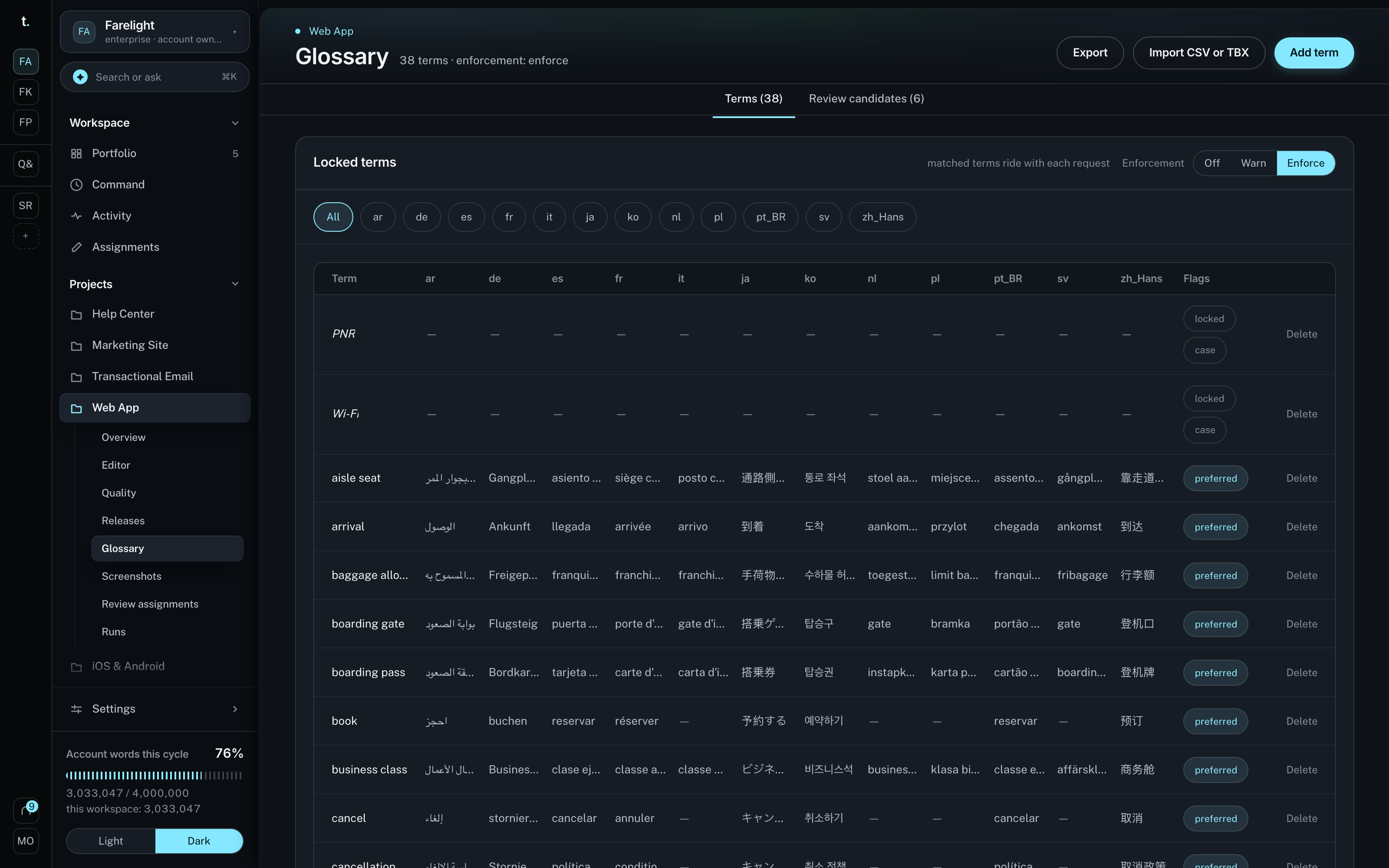
The term list
The words the engine may not change, with their target in every locale beside them.
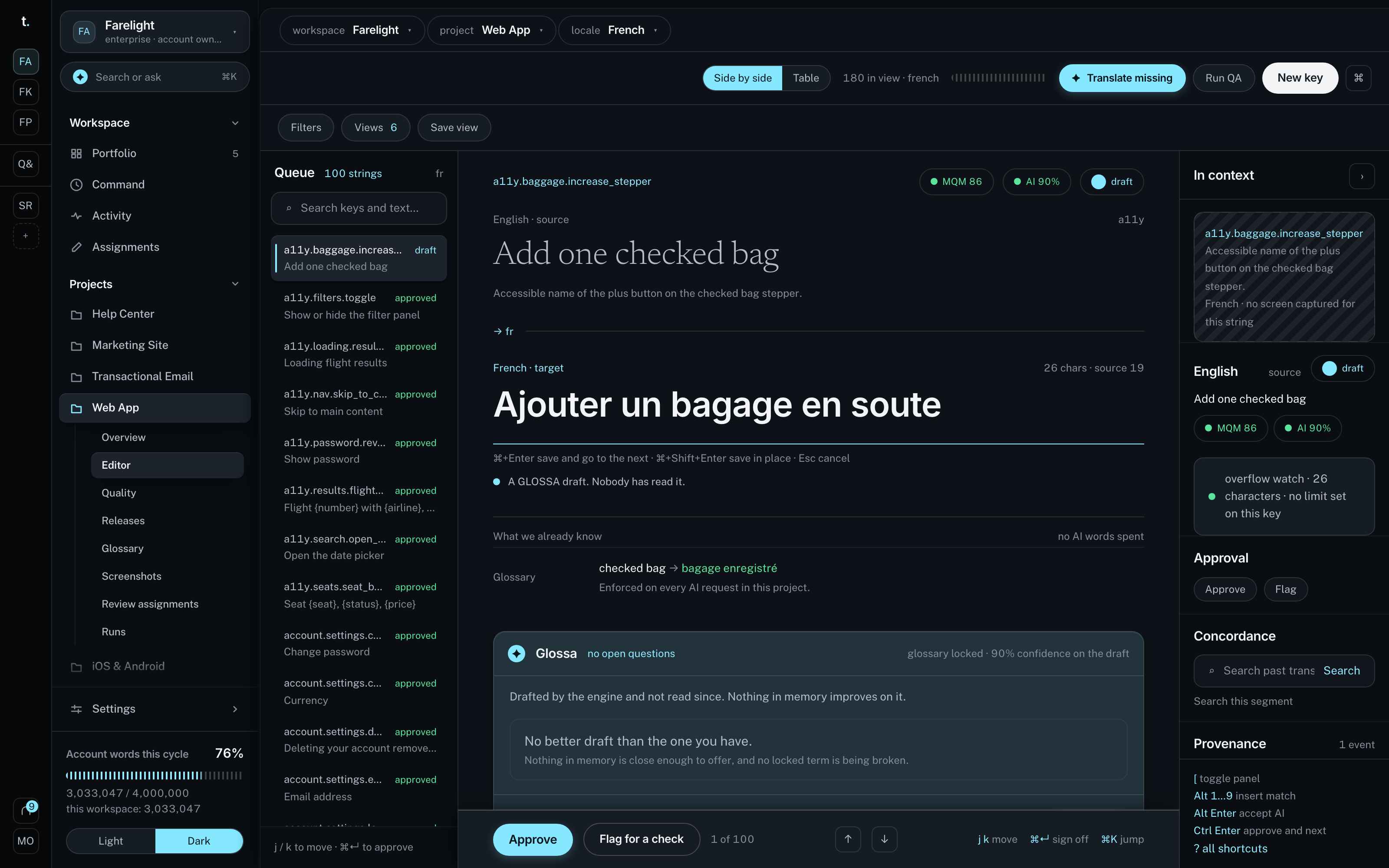
One row, mid-edit
The target open in its field, outlined, with the state of the row beside it.
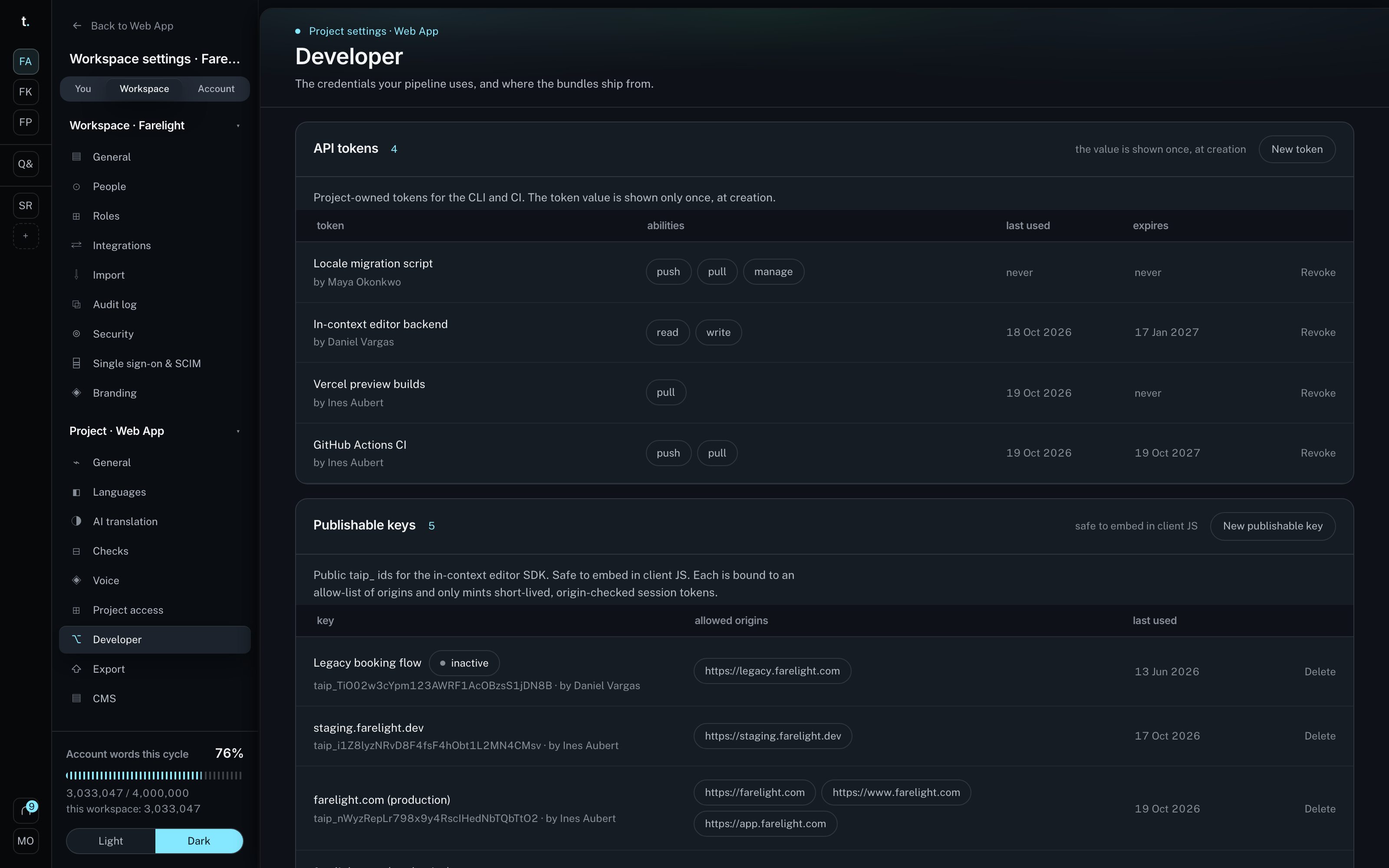
The project controls
Tokens, publishable keys, webhooks, the glossary and the style guide, on one page.
Attested figures.
- 708
locales the validator accepts
Any BCP-47 tag ICU recognises, plus a structural fallback for tags outside the table.
the ICU locale table - 224
languages with their own plural rule set
A translation missing a form its language requires fails the plural gate rather than shipping.
resources/data/plural_categories.php - 4
deterministic checks on every row
Placeholders, plurals, glossary, length. The same four on the pre-gate and on the translate path.
QaRunner::preGate() - 20
file formats read and written
Each one round-trips, so the file that comes back is the file you already had.
the codec list - 12
signed webhook events
Typed, signed and retried in order, with every attempt recorded in the delivery log.
App\Enums\WebhookEvent - $0.0008
per word, past a plan allowance
Free and the open-source grant are hard capped instead of metered, so neither can run up a bill.
config/plans.php
Quoted from the source.
Any BCP-47 tag ICU recognises is canonicalised, with a structural fallback for the tags outside the table.
on what counts as a locale
A row that fails placeholders, plurals, glossary or length is repaired on one corrective retry, or it is blocked.
on what the gate does
Words past a plan allowance meter at $0.0008. Free and the grant tier are hard capped rather than metered.
on what it costs
FAQs
What a reader arrives with, answered plainly.
- What does Transglot actually do?
- It translates the strings in your product into every language you ship, on the push or the sync that changed them, and checks each translation before it can merge. You keep your own files and your own workflow; the languages stop being a project.
- Do I have to rewrite my i18n setup?
- No. It reads the file you already have, from JSON and YAML to gettext, .strings, XLIFF and ARB, twenty formats in all, and writes it back in the same shape. Your keys and your schema are untouched.
- What happens when a translation is wrong?
- Four automatic checks read every row before it can merge: placeholders, plural forms, glossary terms and length. A failing row gets one corrective retry, and if it still fails it is held for review rather than shipped.
- How many languages does it support?
- There is no fixed list to run out of. Any BCP-47 tag ICU recognises is accepted, which is 708 locales in the current table, and 224 of those languages carry their own plural rules that the gate enforces.
- How much does Transglot cost?
- Free is $0 with 100,000 words to start (25,000 at sign-up, 75,000 after a phone check) and 10,000 a month after, 15 locales including your source, three seats and no API. Starter is $19 a month, Team is $49 with unlimited seats, and Business is $149. Words past a plan allowance meter at $0.0008, and paying annually costs ten times the monthly price.
- Is there a free trial?
- The free plan needs no card and does not expire, which is the honest trial. Paid plans start with a 14-day trial on top of it.
- Can human translators still review the work?
- Yes, and most teams keep one reviewer. Translators work in the same grid with their own accounts, and a grant can be limited to a single language so an outside freelancer sees only French.
- Does it work with the tools we already use?
- There are 41 integrations: content systems, design tools, help centres and repositories. None of them costs extra; 36 are included on any paid plan and 5 from the Team plan.
- Do you train models on our content?
- No. Your strings are sent to the subprocessors listed in the Trust Center to be translated and nothing else. The Trust Center is the authoritative record of who can process your content.
- How do I get my translations out again?
- Through the API pull endpoint, the CLI, the delivery bundle or file storage sync. All four need a project token, which arrives on the Starter plan.
41 connectors, already built.
 WordPress
 Contentful
 Sanity
 Storyblok
 Webflow
 Strapi
 DatoCMSHGHygraph
 DrupalKOKontent.ai
 Contentstack
 Prismic
 ShopifyWCWooCommerceWordPressContentfulSanityStoryblokWebflowStrapiDatoCMSHGHygraphDrupalKOKontent.aiContentstackPrismicShopifyWCWooCommerce
 Magento
 PrestaShop
 BigCommerce
 Intercom
 Zendesk GuideFDFreshdesk
 Help Scout
 HubSpot
 Notion
 Confluence
 Ghost
Ghost MailchimpKLKlaviyo
 FigmaMagentoPrestaShopBigCommerceIntercomZendesk GuideFDFreshdeskHelp ScoutHubSpotNotionConfluenceGhostMailchimpKLKlaviyoFigma
 Sketch
 Adobe XD
 GitHub
 GitLab
 Bitbucket
 Azure Repos
 JiraAUZapier, Make and n8n
 App Store Connect
 Google Play
 Google Drive
 Dropbox
 Amazon S3SketchAdobe XDGitHubGitLabBitbucketAzure ReposJiraAUZapier, Make and n8nApp Store ConnectGoogle PlayGoogle DriveDropboxAmazon S3