Documentation reviewed 5 November 2026. Recommendations are editorial analysis; no hands-on translation-quality benchmark is claimed.
Quick answer
AI translation produces drafts at scale. Human expertise resolves ambiguity, adapts language and owns important decisions. Compare complete workflows at the same acceptance standard: source context, deterministic checks, qualified review and versioned publication matter for both approaches.
Why can a translation sound completely natural and still send your customer to the wrong place?
Imagine a billing screen that says “Cancel renewal.” A fluent translation changes it to “Cancel subscription.” The first stops a future charge. The second can suggest that access ends now. Every word looks reasonable, but the product promise has changed.
AI translation is useful for producing drafts at scale. Human translation and review are valuable when meaning, consequences, or brand decisions require judgment. For a software team, the best approach usually combines automation with review rules that reflect the content’s risk. The question is which work to automate, who checks the result, and what happens when the source changes.
Recent translation research also treats the workflow as more than a single model. A WMT 2025 submission covering 11 translation directions combined model adaptation, retrieval of human-translated material, quality-aware decoding, and rule-based postprocessing. It is one research system, not evidence that every commercial product performs equally well. Its design nevertheless shows why context and validation belong in the conversation. Original research: Laniqo at WMT25.
Transglot brings AI translation, translation memory, a keyboard-first editor, and developer-facing APIs into one workspace. Those capabilities are relevant because software localization involves changing strings and coordinated releases, not just a one-off document. They do not remove the need to decide what deserves human attention. Transglot product overview.
This guide compares the approaches, explains their failure modes, and gives you a practical way to test them against your own product.
AI translation vs human translation: the practical difference
AI translation generates a target-language version using a trained model. That can mean a dedicated machine translation system or a language model instructed to translate. Human translation involves a person interpreting the source and writing the target text. In a hybrid workflow, a person reviews and edits machine-generated output before it is approved.
These are methods, not quality grades. A qualified specialist with a clear brief is a different proposition from an unbriefed bilingual colleague. A model supplied with approved terminology and screen context is a different proposition from a chat window receiving disconnected strings.
| Decision | AI draft without review | Human translation | AI with human review |
|---|---|---|---|
| First draft | Automated; throughput depends on service limits | Depends on translator availability and complexity | Automated draft followed by a review queue |
| Ambiguous meaning | Can choose a plausible interpretation silently | Can ask questions and investigate the product | Works best when ambiguity is flagged for review |
| Repeated content | Useful with approved memory and terminology | Can reuse the same translation assets | Combines reuse with selective intervention |
| Creative copy | Offers candidate wording | Supports deliberate adaptation for an audience | Useful for exploring options with editorial ownership |
| Technical integrity | Requires deterministic validation | Still requires deterministic validation | Validation plus linguistic review |
| Cost driver | Generation, integration, monitoring, and corrections | Translation, research, revision, and coordination | Generation plus actual review and correction effort |
| Accountability | Your team owns publication decisions | A named person can own linguistic decisions | Your team must define approval responsibility |
This comparison is a workflow assessment, not a benchmark of named products. The team has not run a controlled translation test for this article. The examples below are illustrative, and the proposed evaluation method is something you can implement with your own reviewers.
Why software teams need more than translated text
Localization exists because customers need to understand and use a product in their own setting. A translated signup page is only the beginning. The confirmation email, payment step, error message, support article, and cancellation flow must agree with it.
Internationalization is the engineering preparation that makes this possible. Localization adapts the resulting product for a particular audience. W3C describes localization as broader than text translation, including conventions such as dates, numbers, currency, and other cultural requirements. W3C: Localization vs. Internationalization.
Consider a release that changes “workspace” to “organization.” The change can affect navigation, invitation emails, documentation, and permission descriptions. Translating one file correctly does not guarantee a consistent experience across those surfaces.
This is how translation debt accumulates. New source copy ships while older translations remain live. People lose track of which spreadsheet is current. Reviewers correct a term in one place but never update the shared glossary. Engineers spend time reconciling files instead of improving the product.
Spreadsheets and email are workable when the content is small and stable. As change accelerates, teams need clearer ownership and automated handoffs. Translation memory reduces repeated work; localization platforms organize it; continuous localization connects it to ongoing changes. AI adds another way to produce drafts inside that system.
A faster draft is valuable only if it reaches users as a correct, current release.
Where AI translation helps most
Repetitive, well-defined product content
A settings panel with clear labels and stable terminology gives an automated system a manageable task. The source is concise, the domain can be explained, and previous approved translations provide useful examples.
The conditions matter. “Archive” might be a button, a noun, or a storage destination. A key such as “projects.archive_button,” together with a description of what the button does, gives both a model and a translator more information than the word alone.
The recommendation is to start with content whose purpose is clear and whose mistakes are easy to detect and reverse. That is a narrower and more useful category than “all short strings.” A two-word payment instruction can deserve more scrutiny than a long internal help paragraph.
Drafting across changing content
AI can help teams generate candidates when many entries change together. A CMS update to a product category, for example, can create a substantial translation queue. Automated drafts let reviewers begin with text in place.
But availability of a draft is different from availability of a reviewer. If generation fills the queue faster than reviewers can resolve it, the bottleneck has moved. Track the time from source change to approved publication, not just the duration of the model request.
For developer documentation, the same principle applies. An automated draft can cover explanatory prose while code examples remain protected. Someone still needs to check that the translated explanation describes the actual behavior.
Exploring alternative wording
A model can offer several phrasings for a short onboarding message. That is useful when a reviewer wants to compare formality, directness, or length.
Treat these options as proposals. Asking for a friendlier version does not authorize a change to the product promise. “You can try this feature” and “This feature is included” are different claims, even when both sound welcoming.
A good brief specifies what can change and what must stay fixed. It separates brand voice from factual meaning.
Original Transglot editorial artwork · Explore Transglot
Explore Transglot’s translation workspace →
Where human translation and review add the most value
Resolving uncertainty about the product
A translator can notice that the source itself is unclear and ask the product owner what it means. That question can improve every language, including the original.
Suppose a message says “Your account will be removed.” Does that mean a user loses access to a team, a profile is deactivated, or stored data is deleted? Better translation starts with answering that question. Neither a fluent model nor a skilled translator should be expected to infer undocumented behavior reliably.
Give reviewers a route to the people who know the answer. A comment attached to the string is useful only if someone responds and the decision remains available for future revisions.
Choosing how a brand should speak
A launch headline is an editorial decision. A literal translation can preserve the words while missing the reason someone would care. A specialist can change the phrasing, rhythm, or cultural reference while keeping the underlying offer accurate.
This work is often called transcreation. It needs an audience brief and permission to adapt. Asking a reviewer to “check the translation” is too vague when the actual assignment is to write persuasive local copy.
Agree on the intended outcome first. Is the headline supposed to explain a feature, create curiosity, or reassure a skeptical buyer? Different goals call for different language.
Reviewing content with significant consequences
Some strings explain irreversible actions, access rights, charges, or sensitive decisions. Specialist review is recommended for these because a small semantic change can have an outsized effect on the customer.
This is a product risk recommendation, not a claim that all such content has identical legal requirements. Your organization still needs to establish the right approval process for its products and markets.
Human involvement also needs structure. A rushed reviewer who lacks context is not a reliable safeguard. Give the person a defined responsibility, enough time, and a way to reject unsuitable output.
Why “How accurate is AI translation?” has no single percentage
Accuracy depends on the language direction, subject, source quality, available context, and definition of an error. A system that works well on support articles can struggle with isolated interface labels. Results for one language do not establish results for another.
The WMT 2024 general translation task evaluated 11 language pairs across test sets containing three to five domains. It included outputs from eight large language models and four online translation providers, alongside participating systems, and used professional human annotators. That scope illustrates why a credible evaluation specifies its conditions. Original research: WMT24 general translation findings.
For your product, separate several questions. Does the translation preserve the meaning? Does it use the right terminology? Does it sound natural for the intended audience? Does it preserve the application’s required structure? Can users complete the task?
A single score can hide the difference between a cosmetic issue and a dangerous misunderstanding. “Slightly awkward” and “reverses the meaning of a permission” should not carry equal operational weight.
Fluency can conceal a mistake
Readers often notice broken grammar quickly. They can miss a smooth sentence that omits a condition. For example, “Available after your administrator approves access” becomes misleading if the approval requirement disappears.
Back-translation can offer a clue, but it is not proof of correctness. A second model can reconstruct a reasonable source sentence without exposing the original problem. Compare the target directly with the source and product context whenever the content matters.
Human output also needs quality control
Human translators can misunderstand a feature, overlook a changed number, or reuse outdated terminology. Hiring a person does not eliminate the need for review, shared assets, or technical checks.
The useful comparison is between complete workflows at the same acceptance standard. Comparing an unchecked AI draft with a professionally revised human translation tells you something about those deliverables, but not whether a properly reviewed hybrid process meets your requirements.
Who evaluates the output can change the answer. Freitag and colleagues’ 2021 study re-evaluated WMT2020 English-to-German and Chinese-to-English outputs with professional translators, full document context and explicit MQM error annotations. The resulting rankings differed substantially from crowd-based evaluations; human translations ranked above machine outputs in those experiments. Major meaning errors explained much of the distinction. These are older systems and two language directions, not a ranking of today’s products. The enduring lesson for a product pilot is methodological: ask qualified reviewers to identify the error and its consequence, rather than only rating how natural a sentence feels. Freitag et al., study design and results.
Build review rules around consequences
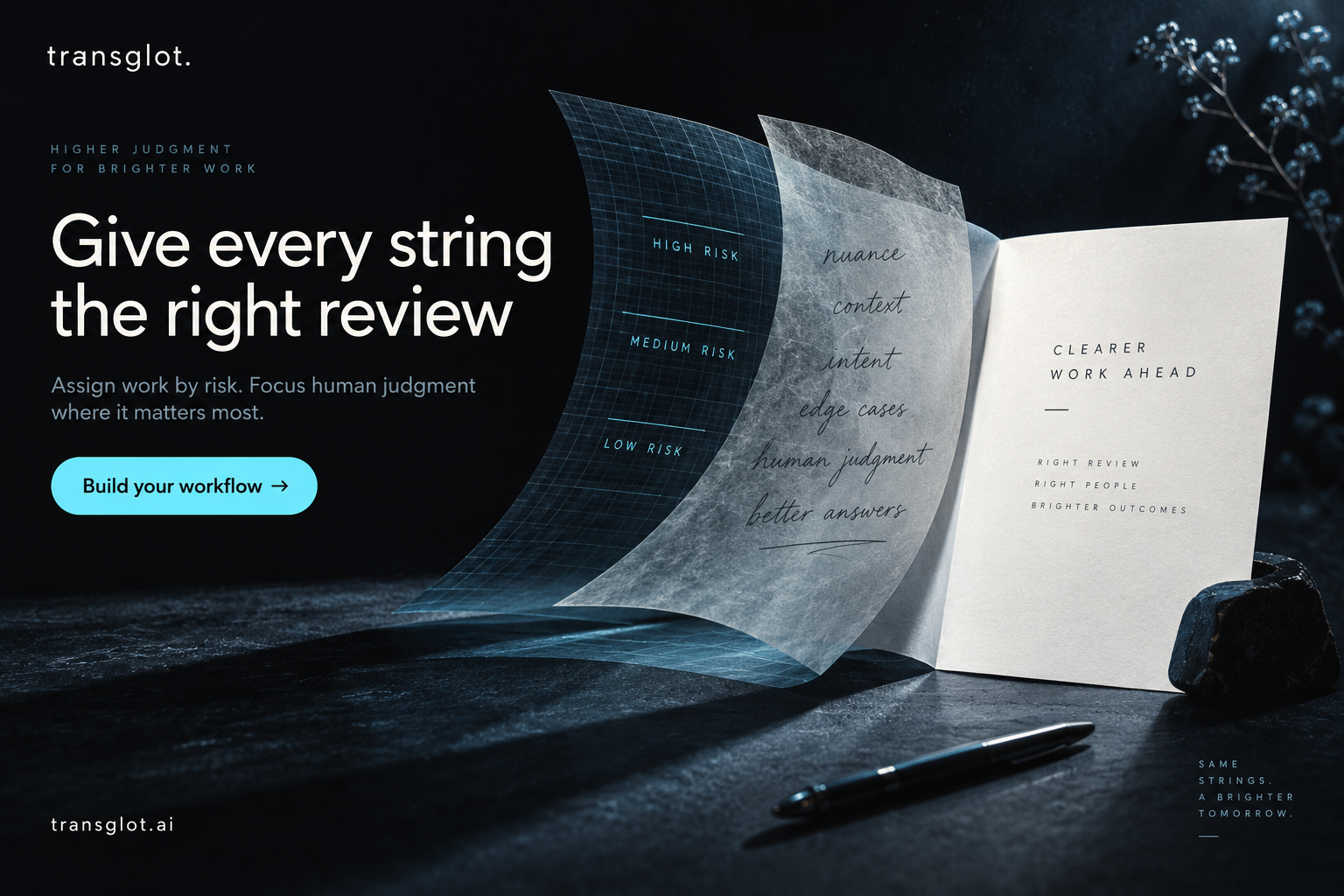
Start by grouping content according to what happens if the translation is wrong. Use that grouping to determine review depth and release gates.
Routine descriptive content can enter an AI-assisted workflow with a clearly defined quality check. New interface flows deserve review in the product because meaning depends on the surrounding controls. Destructive actions, financial commitments, and permission changes should have named approval owners.
There is no universal rule that a particular content type is always safe. A help article about changing a theme is different from a help article about deleting a workspace. The consequence of a misunderstanding matters more than the file extension.
Define exceptions too. An unfamiliar language, an unexplained term, or a source change that alters behavior should trigger additional attention even if the content normally follows a lighter process.
Auto-approval is a release policy. It should be earned through evidence, not inferred from fluent output.
For any category you automate, record the conditions under which automation stops. A missing placeholder, a changed source revision, or an unresolved reviewer question should prevent that item from slipping into a release.
Original Transglot editorial artwork · Build your workflow
See how Transglot can fit your workflow →
A hybrid translation workflow for a real release
Prepare the source and its context
Before translation, make the source understandable. Use stable keys, complete messages, and clear descriptions. Avoid assembling a sentence from fragments that assume English word order.
For a billing message, include the screen name, the event that triggers it, the meaning of each variable, and any length constraint. If a number represents a subscription price, say whether it already includes currency formatting.
Screenshots help show relationships that a string list hides. A button beneath a destructive-action warning needs different interpretation from an identically named button in a navigation menu. Keep screenshots current; stale context can be actively misleading.
Reuse approved work carefully
A translation memory stores source and target segments for reuse. A glossary records preferred terminology and its meaning. These assets serve different purposes: one remembers previous translations, while the other guides consistent word choices.
An exact text match is not always an exact context match. “Open” can describe a ticket status or instruct a user to open a file. Reusing approved text is useful when the locale, meaning, and context still fit.
Keep ownership visible. When terminology changes, identify which stored translations need attention. Otherwise, memory can preserve yesterday’s mistake with impressive consistency.
Original Transglot editorial artwork · Localize with Transglot
Generate a constrained draft
Give the system explicit instructions about the target locale, terminology, protected content, and output shape. A structured file should return as a valid structured file, not a conversational explanation.
For example, a translator-facing brief could say: “Translate the displayed message for French users of this billing screen. Preserve the variable names exactly. Cancellation stops the next renewal; access remains available until the paid period ends.”
That brief does more work than “translate to French.” It supplies the decision that the output must preserve. Still, instructions are not validation. Check the returned file independently.
Run technical checks before linguistic approval
Parse the output using the same format expectations as the application. Check for missing keys, unexpected keys, damaged markup, and altered variables. Where a placeholder can legitimately repeat, validate the permitted structure rather than using a simplistic unique-name comparison.
Plural behavior deserves special attention. Unicode CLDR defines plural categories that differ across languages; an English singular/plural pattern is not a universal template. Validate the target locale’s required messages with the application’s localization framework. Unicode CLDR plural rules.
These checks protect human-written translations too. A translation can be linguistically excellent and still fail when the application tries to render it.
Review meaning, then test the screen
Give the reviewer the source revision, target text, glossary, context, and technical findings together. Separate an unresolved question from an approved translation. “Someone looked at it” is not a useful release state.
After linguistic review, inspect the running product. Check truncation, line wrapping, button relationships, and whether the translated message appears at the right moment.
For a CMS, preview the full page with navigation and calls to action. For a repository, build the relevant branch. A correct string placed in the wrong component is still a customer-facing error.
Publish the approved revision
Tie approval to the source version. If the source changes after review, the previous approval should not silently apply to a different message.
A repository workflow can return reviewed translations through a pull request, while a CMS workflow can publish an approved entry. The exact implementation depends on the integration. In either case, retain enough history to explain which source and translation versions went live together.
If you deliver translations at runtime, use the same discipline. Decoupling text updates from application deployments does not make compatibility checks or rollback unnecessary.
Validate a whole message, not a bag of matching variables. ICU’s MessageFormat guidance recommends keeping complete messages together so translators can move arguments and choose grammatical branches. The same placeholder names can appear in an output whose sentence structure is still wrong. A practical acceptance check renders representative values through the target locale’s real message formatter, then reviews the resulting sentences in context. A placeholder check and a linguistic review answer different questions. ICU message formatting guidance.
Compare costs at the same quality standard
AI generation costs are only one line in the budget. Human translation quotes also need interpretation: some include revision or project management, while others do not.
Compare the cost of producing an accepted release. Include preparation, generation or translation, review, engineering support, and correction after publication. Count waiting time separately from active work, since a cheap workflow can still delay a launch.
Here is a deliberately hypothetical example, not a price quote or industry benchmark.
Assume a release contains 10,000 new source words for one target language. For a human-led workflow, suppose translation and revision together cost $0.12 per word and coordination takes two hours at $50 per hour. The modeled total is $1,300.
For a hybrid workflow, suppose generation costs $20, review takes 12 hours at $50 per hour, and engineering plus coordination takes four hours at $50 per hour. The modeled total is $820.
Now change one assumption. If review takes 22 hours because the draft requires substantial correction, the hybrid total becomes $1,320. The apparent savings disappear.
The arithmetic is simple; measuring the inputs is the real work. Use actual review time from representative content, include setup costs, and compare against the same acceptance criteria.
A useful operating metric is cost per accepted source word per target locale. Pair it with critical error counts and time to approval. A low cost that depends on tolerating worse output is a different business decision from a more efficient process.
Run a pilot before choosing your approach
Choose a small but representative batch from the product you actually ship. Include ordinary labels, ambiguous strings, documentation, variables, and content with important consequences. Test more than your easiest language direction.
Create a human-led baseline and an AI-assisted version under comparable conditions. Give both the same source context, glossary, and acceptance criteria. Keep the evaluator separate from the author where practical, and hide the production method during scoring when possible.
Record errors by category and severity. A terminology mismatch, an omission, and a broken variable need different fixes. Measure active editing time as well as elapsed delivery time.
Agree in advance on what would make the pilot acceptable. For example, your team can require no unresolved critical errors in the reviewed release and no failed structural checks. That is an acceptance rule for the pilot, not proof that future output will be flawless.
Finally, repeat the test after meaningful changes to the model, prompt, glossary, or content domain. A successful initial trial establishes a baseline. It does not grant permanent permission to skip checks.
Extra prompt instructions can make a system worse. In the Laniqo WMT25 paper’s appendix, adding automatically detected named entities to prompts lowered the reported macro-average COMET score on WMT24++; using those entities as terminology constraints also failed to improve results. A domain-specific prompt was abandoned after it did not improve translation quality. This was one EuroLLM-based research pipeline, evaluated with automatic metrics, not a finding about manually approved glossaries or every model. The practical inference is to test each proposed intervention against the same baseline before making it part of the workflow. More instructions are not evidence of better output. Laniqo, appendices A and C.
Where Transglot fits into the decision
A translation engine generates text. A localization workspace helps a team manage the work around it. Decide which problem is consuming your time before selecting software.
Transglot’s documented keyboard-first editor is relevant when people need to work through large sets of strings. Its API documentation describes access to translations, projects, and glossaries, with signed webhooks. Those are useful building blocks for connecting translation work to an existing engineering process. Transglot editor, Transglot API.
Evaluate those capabilities with your own files. Can reviewers find the context they need? Can your integration distinguish a draft from approved content? Can you trace an output to its source version? Does your actual file structure survive import and export?
Before sending confidential material to any service, review its current data handling terms and your organization’s requirements. For Transglot, start with its published security information, then resolve any deployment-specific questions directly. This article does not claim a certification or contractual guarantee. Transglot security.
For a broader shortlist, the companion draft, Best AI Translation Software for Apps, compares localization software through the workflow it supports.
Separate core review tools from plan-specific automation. Transglot offers row-level context, history and review in its editor. Developer tokens start on paid plans; the engine’s Quality Mode starts on Team. The quality page also distinguishes repair modes: suggest waits for a decision, while apply makes one repair and checks again. These capabilities support a review process; they do not establish semantic correctness or prove time savings. Editor · API access · Engine conditions · Repair modes.
One data-handling detail to resolve during evaluation: Transglot’s security page describes a shared exact-match memory pool that a project can leave. It also states that live database volumes are not currently disk-encrypted, although backups are encrypted, and that no third-party security certification is held today. For confidential material, assess these published boundaries against the intended deployment before treating a product’s translation quality as the only purchase criterion. Transglot’s published controls and limitations, checked 5 November 2026.
Frequently asked questions
Is AI translation better than human translation?
It depends on the job and the acceptance standard. AI can produce drafts for a large volume of content without waiting for a person to write every sentence. A qualified human translator can investigate ambiguity, challenge the source, and make deliberate editorial choices. Neither label guarantees a correct release. Compare the complete processes, including context, revision, and technical validation. For software teams, a hybrid process is worth testing when the source is clear and reviewers can correct output efficiently. Human-led work is often the stronger starting point when the brief requires substantial adaptation or when uncertainty about meaning dominates the task.
Can AI replace human translators for app localization?
It can replace some drafting work in a defined workflow, but that is different from replacing the responsibilities of a translator. Someone still needs to establish terminology, resolve unclear source messages, judge suitability for the audience, and decide whether the result is ready. The amount of human effort can change from one content group to another. The recommendation is to test automation on well-understood content first and keep explicit review ownership for important user actions. If you remove a drafting step, make sure the questioning, revision, and accountability that previously came with that step still have a place in the process.
What is machine translation post-editing?
Post-editing means reviewing and correcting machine-generated translation. The assignment should specify the required finish: basic comprehension and publication-quality product copy are different targets. A reviewer needs the source text and relevant context, not just the generated sentence. They should check meaning, omissions, terminology, tone, and any required constraints. They also need permission to rewrite an unsuitable draft or report a source problem. Estimate this work from actual samples rather than assuming it is always quicker than translation from scratch. A difficult draft can consume time because the reviewer must first uncover its errors and then reconstruct the intended message.
Does human review guarantee an accurate translation?
No. Review improves the opportunity to catch errors, but its effectiveness depends on the reviewer’s language skills, domain knowledge, context, and available time. It also depends on what the review asks them to check. A quick fluency pass can miss a changed permission or an omitted condition. Assign a named owner, provide the source revision, and define what counts as approval. Use technical validation for issues such as missing variables and malformed files. For important flows, inspect the translation in the product. Combining these checks gives you more useful evidence than simply marking a string as having been seen by a person.
Should we use the same translation workflow for every language?
Use the same operational principles, but allow different review depth and routing. Keep source versioning, technical validation, ownership, and publication history consistent. Then adapt the linguistic process to the evidence you have for each language and domain. A good result in one direction does not establish quality elsewhere. Reviewer availability also matters: a workflow that depends on an unavailable specialist will create a queue. Run representative pilots and record where correction effort is high. When launching a new locale, begin with closer review, then change the policy only after you have enough evidence about the actual content and process.
Why do short app strings cause translation problems?
Short strings often omit the information needed to interpret them. “Save,” “Open,” and “Free” can have different meanings depending on where they appear. Translators also need to know whether a phrase is a button, status, heading, or instruction. A clear key name helps, but it cannot replace a description of the behavior. Supply the screen, surrounding messages, variable meanings, and any display constraints. If the source remains ambiguous, clarify it before translation. Adding context is useful for both people and models, and it can prevent repeated questions every time the same component changes during a release.
How should a startup choose between AI and a translation agency?
Start with the content and the work your team can realistically own. A startup with well-structured app strings, engineering support, and access to qualified reviewers can test an AI-assisted workflow. A team launching into an unfamiliar market with substantial brand adaptation needs can benefit from external specialists. These choices are compatible: an agency can review output inside a localization platform. Ask who owns terminology, source questions, revision, and release coordination. Compare complete deliverables at the same quality level. A low generation bill is not an adequate substitute for a process that your small team can operate consistently.
What should we measure after launching a hybrid workflow?
Track quality, effort, and delivery together. Record critical errors separately from minor style issues, and measure the time reviewers actually spend correcting a representative batch. Track how long content waits for approval and how often published translations need correction. Investigate recurring patterns rather than treating every edit as an isolated event. Repeated terminology fixes suggest a glossary problem; repeated misunderstandings suggest missing context or unclear source copy. Keep results separated by locale and content type where useful. The goal is to learn which work is becoming more reliable and which work still needs additional human attention before publication.
Choose the workflow your product needs
AI translation vs human translation is ultimately a decision about how your team produces and approves meaning. Automation can make drafting more accessible. Human expertise can resolve uncertainty and protect intent. Shared terminology, technical checks, and versioned releases make both methods more dependable.
Start with one representative workflow. Define the acceptance standard, measure the real review effort, and expand only where the evidence supports it.
If your team needs a connected place for AI translation, reusable language assets, and string editing, explore Transglot with a sample of your own product content. Choose the process that helps your team ship language it can stand behind.
Original Transglot editorial artwork · Explore Transglot
Explore Transglot and test it on your own product →
Test one real workflow against your own acceptance standard.Explore Transglot ↗
Sources
Research and official documentation checked 5 November 2026. WMT24 establishes the scope of its evaluation; the older MQM study informs evaluation method, not current model rankings. Laniqo’s results describe one research system and its test sets. Product pages describe documented capabilities, not an independent performance test. The calculators use hypothetical inputs.
- Laniqo at WMT25 · research submission
- Transglot product overview
- W3C · localization and internationalization
- WMT24 General Translation Task · evaluation scope
- Unicode CLDR · plural rules
- Transglot editor and review workflow
- Transglot API and paid token access
- Transglot security controls and current limitations
- Freitag et al. · Experts, Errors, and Context (2021)
- ICU · whole messages and complex arguments
- Laniqo at WMT25 · full paper and negative experiments
- Transglot engine and Quality Mode conditions
- Transglot checks and repair modes