A Localize alternative for teams with string files
Localize translates websites and web apps from a JavaScript integration, without string files, and prices each customer by quote from $25,000 a year. Below is what the pricing page says it includes, what drives the quote, and how to export Localize phrases into files Transglot reads.
Prices on the page
Localize quotes every plan, from $25,000 a year, without saying what volume that covers; Transglot publishes each plan's price and allowance.
Locale files in your repo
Localize translates through a JavaScript integration on the live site; Transglot reads and writes the locale files in your repository.

Where Localize wins, and the catch.
Live sites, stores and web apps
Localize suits marketing and product teams that need a live website, store or web app translated without engineers maintaining string files, with compliance such as SOC 2 Type II and HIPAA.
- The limitEvery plan is quoted from content volume, page views, languages, compliance and review needs, starting at $25,000 a year.
- TransglotTransglot does not translate a live website without string files. It works on the locale files your app loads, on published plans.
Multilingual SEO and on-page editing
Localize handles multilingual SEO with translated titles, meta descriptions and hreflang tags, and has an on-page editor.
- The limitA site translated through the snippet has no string files in the repository, so leaving later means moving the text into locale files first.
- TransglotTransglot has no proxy or snippet. Translations stay in your repository's locale files, with an in-context editor on paid plans.
An account team and human translation
A dedicated customer success manager, SLAs and quarterly business reviews come with the contract, and vendor partners supply human translation.
- The limitProfessional human translation is billed separately by word count and language pair, on top of the quoted plan.
- TransglotTransglot supplies no human translators. Glossa Deep adds a quality pass from Team, and your own reviewers work in the browser.
Localize vs Transglot, per translated word.
Both tools priced for the same workload. The per-word figure is the monthly cost divided by the translated words in that workload.
| Figure | TransglotTeam | LocalizeCustom plan (quoted, from $25,000 a year) |
|---|---|---|
| Plan that holds the workload | Team 1,000,000 translated words a month included. | Custom plan (quoted, from $25,000 a year) Localize publishes no plan sizes. The FAQ names a Basic Platform (credit card billing only) and an Advanced Platform (invoicing, personalized onboarding, priority support), both priced by quote. The $25,000 a year starting point is about $2,083 a month, but the page does not say what volume that covers, so no per-word figure is shown. |
| Listed price | $39 a month Launch price for new subscriptions. List price $49 a month. | Custom pricing; the pricing page says plans start at $25,000 a year and publishes no plan price |
| Monthly cost for this workload | $39 a month | Quoted on request |
| What the price counts | Words per target language Each source word counts once for every language it is translated into. | Quoted per contract Localize quotes each customer from content volume (the words translated and kept current), page views of localized pages, the number of languages and projects, complexity and compliance, and review needs. This workload is 400,000 translated words a month into 10 languages; the page gives no unit price to divide it by. |
| Price per translated word | $0.0000975 | Quoted on request |
- Plan that holds the workload
- Team1,000,000 translated words a month included.
- Listed price
- $39 a monthLaunch price for new subscriptions. List price $49 a month.
- Monthly cost for this workload
- $39 a month
- What the price counts
- Words per target languageEach source word counts once for every language it is translated into.
- Price per translated word
- $0.0000975
- Plan that holds the workload
- Custom plan (quoted, from $25,000 a year)Localize publishes no plan sizes. The FAQ names a Basic Platform (credit card billing only) and an Advanced Platform (invoicing, personalized onboarding, priority support), both priced by quote. The $25,000 a year starting point is about $2,083 a month, but the page does not say what volume that covers, so no per-word figure is shown.
- Listed price
- Custom pricing; the pricing page says plans start at $25,000 a year and publishes no plan price
- Monthly cost for this workload
- Quoted on request
- What the price counts
- Quoted per contractLocalize quotes each customer from content volume (the words translated and kept current), page views of localized pages, the number of languages and projects, complexity and compliance, and review needs. This workload is 400,000 translated words a month into 10 languages; the page gives no unit price to divide it by.
- Price per translated word
- Quoted on request
One workspace, from first draft to release.
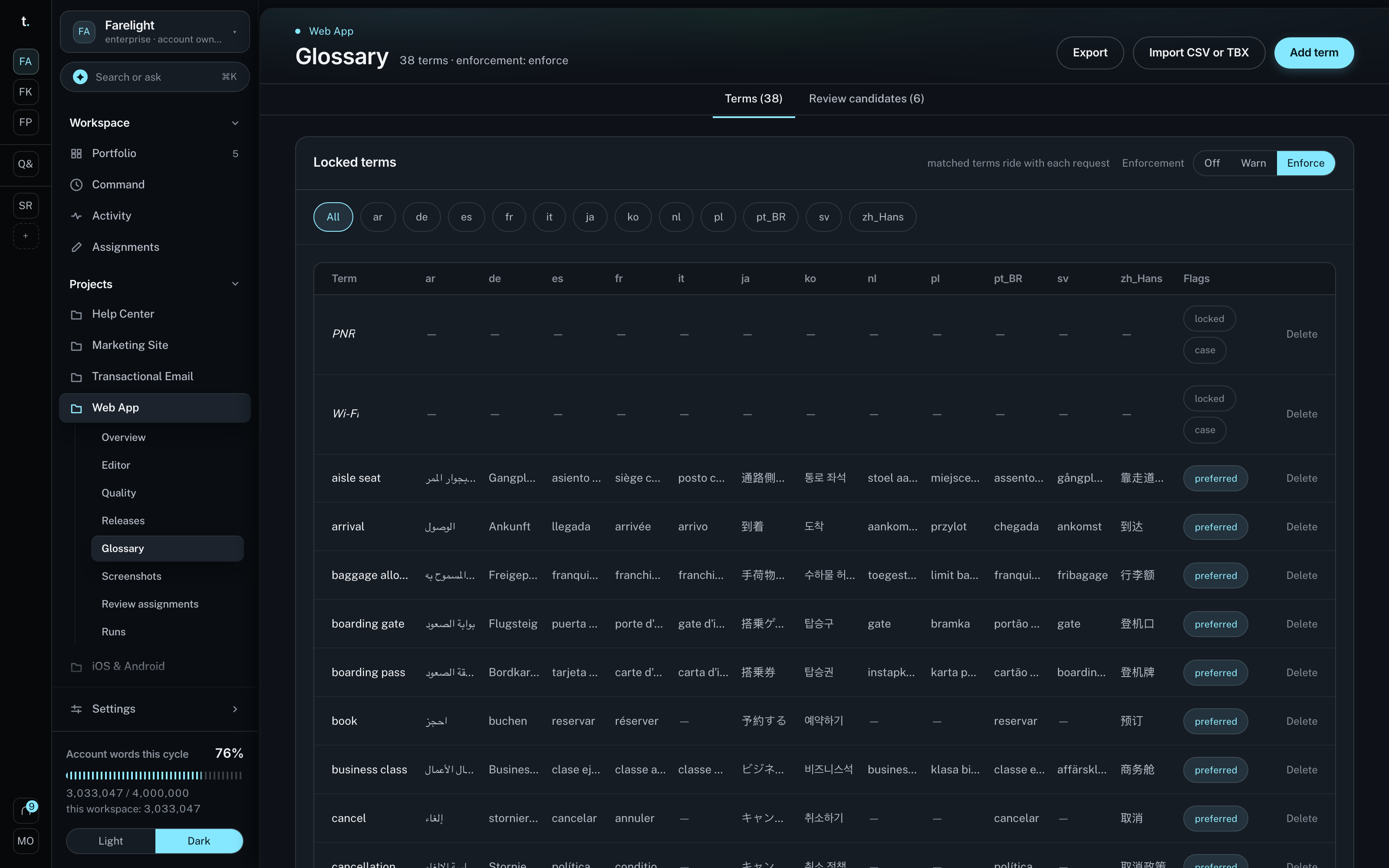
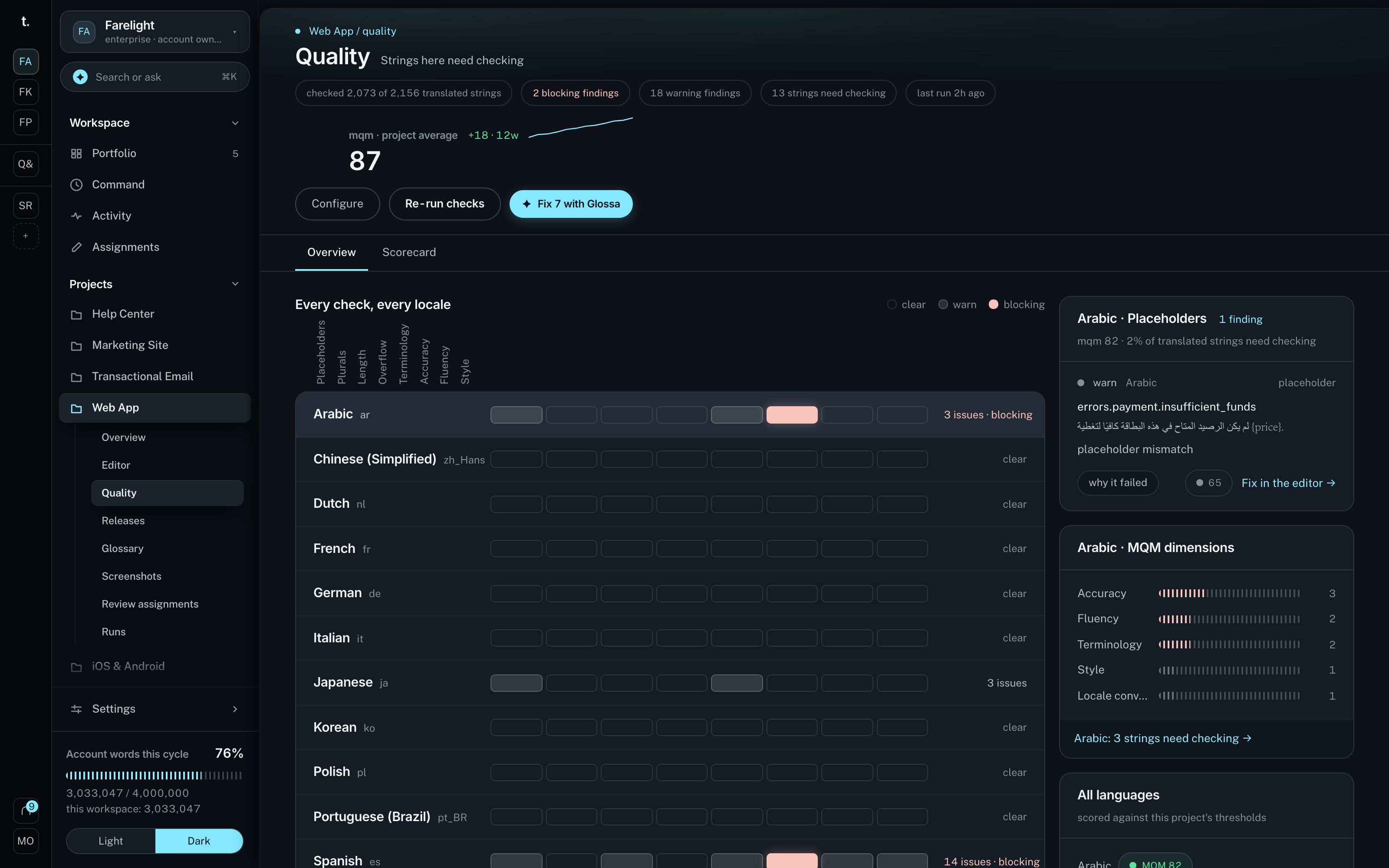
Real screens from the console, on a demonstration project.
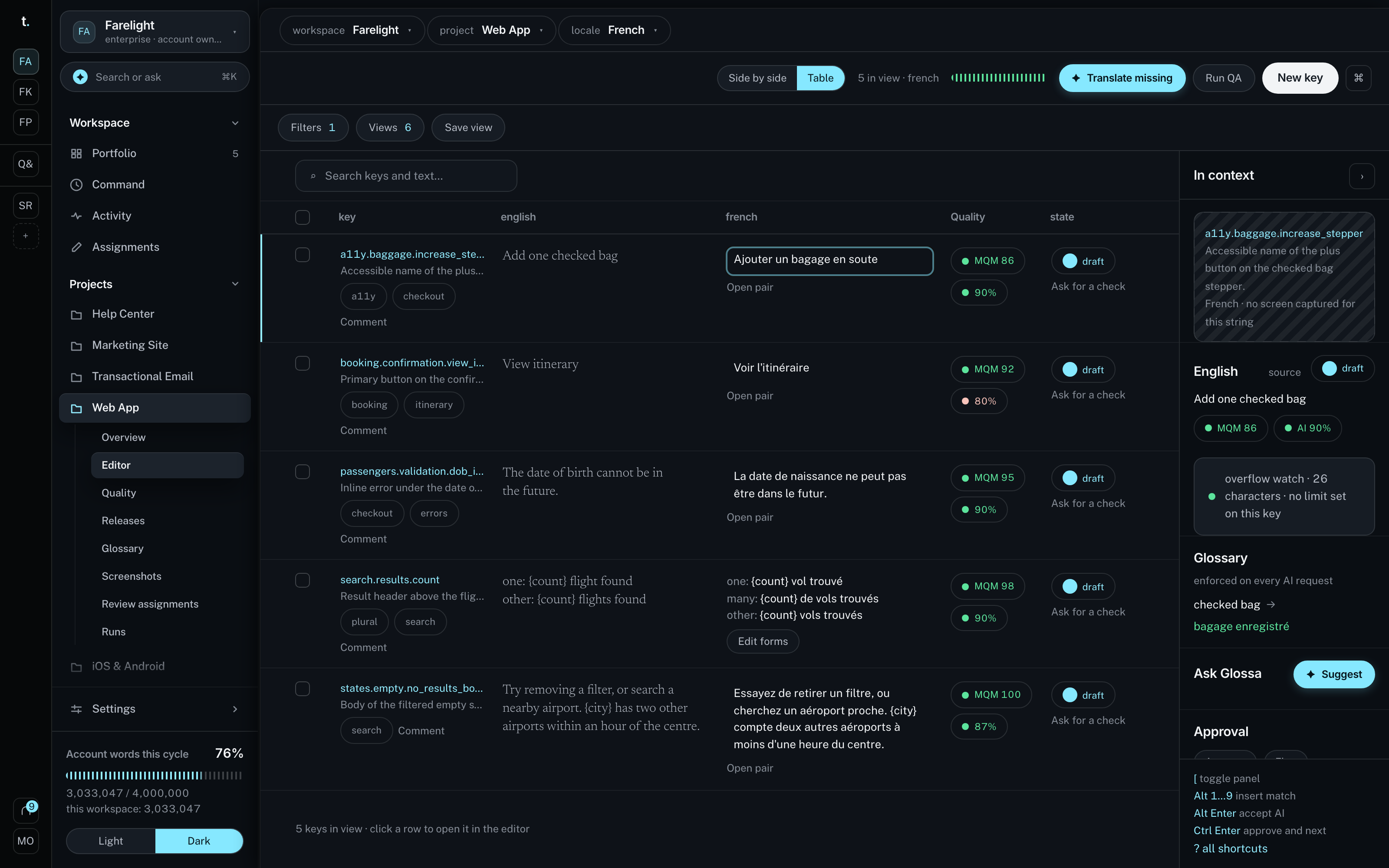
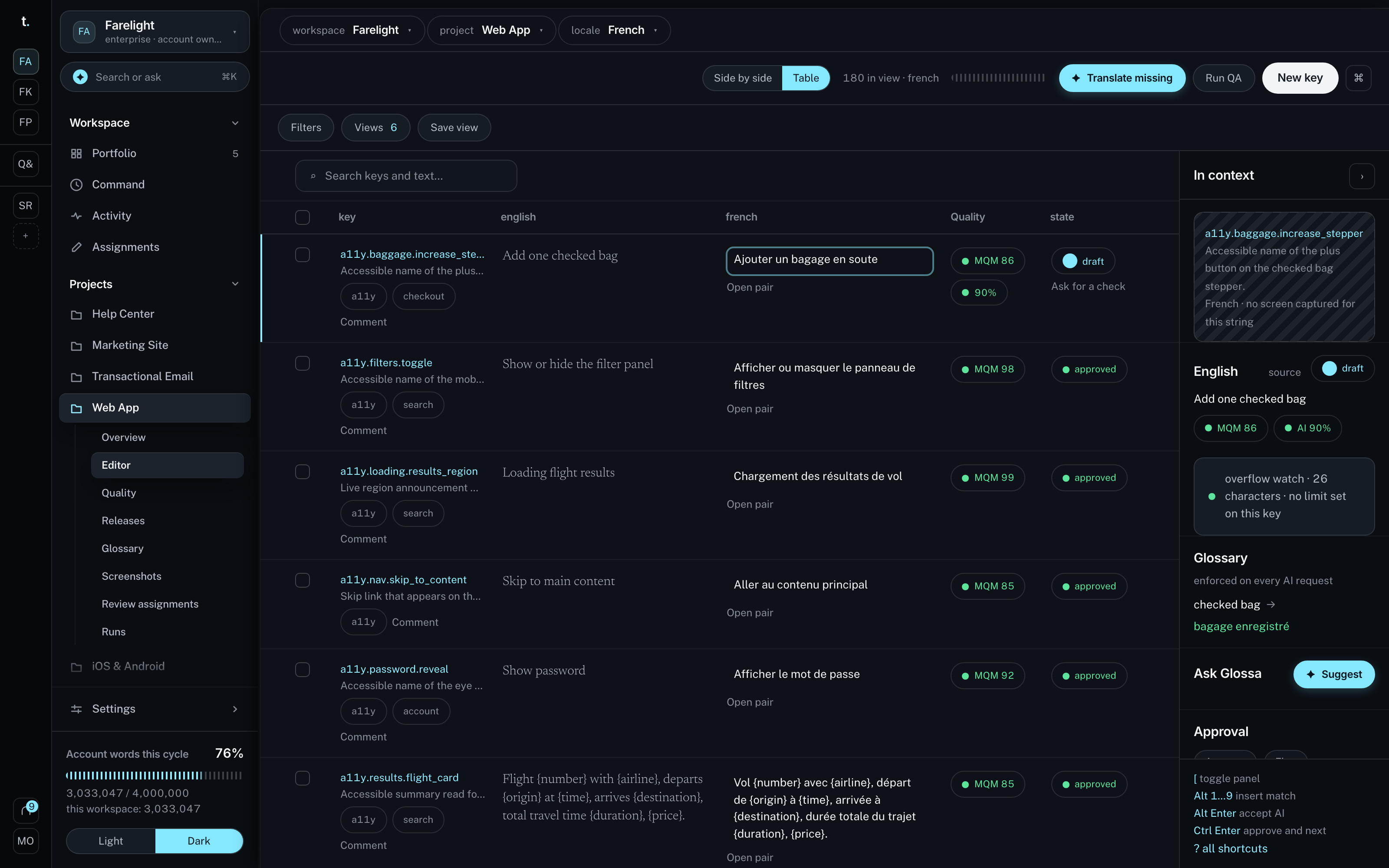
Transglot finds new strings on every push and Glossa drafts each language you have configured, inside the plan's word meter.
The source and every language sit side by side in the browser. A reviewer edits a cell and the next pull carries it.
Load the terms that must stay put. They go into every draft and are checked again afterwards.
Placeholders, plurals, glossary and length are checked on every row. A broken placeholder, plural or forbidden term gets one repair, then the row is refused rather than shipped. A length overrun is written, not refused.
What each tool includes.
| Feature | Transglot | Localize |
|---|---|---|
| Capabilities | ||
Website translation without string filesLocalize: JavaScript integration with automatic content detection. | ×No | ✓Yes |
AI translation included in the planLocalize: AI-assisted translation included in custom plans. | ✓Yes | ✓Yes |
In-context editorTransglot: paid plans. Localize: on-page in-context editing. | ✓Yes | ✓Yes |
| Translation memory | ✓Yes | ✓Yes |
GlossaryTransglot: paid plans. Localize: style guide and glossary. | ✓Yes | ✓Yes |
APITransglot: paid plans. Localize: REST API in the developer docs. | ✓Yes | ✓Yes |
Free planLocalize: free trial, no credit card required. | ✓Yes | ×No |
Published priceLocalize: a starting point of $25,000 a year; every plan is quoted. | ✓Yes | Partly |
- Website translation without string files
- ×No
- AI translation included in the plan
- ✓Yes
- In-context editor
- ✓Yes
- Translation memory
- ✓Yes
- Glossary
- ✓Yes
- API
- ✓Yes
- Free plan
- ✓Yes
- Published price
- ✓Yes
- Website translation without string files
- ✓Yes
- AI translation included in the plan
- ✓Yes
- In-context editor
- ✓Yes
- Translation memory
- ✓Yes
- Glossary
- ✓Yes
- API
- ✓Yes
- Free plan
- ×No
- Published price
- Partly
Switch from Localize in three steps.
In the Localize dashboard, open File Import / Export, choose the Export tab, select the languages and a file format (CSV, JSON, PO, RESX, XLIFF or XML); Localize downloads one file per language. Transglot reads the XLIFF, PO, RESX and CSV exports; the Localize JSON export is a list of phrase objects rather than key-value pairs, so XLIFF or PO is the closer match. A website translated through the snippet has no string files in the repo, so the text needs to move into your app's own locale files first, then run npx transglot@latest init or upload them.
- 01
Export from Localize
Download your translation files in a format Transglot reads.
XLIFFJSONPOAndroid XMLiOS strings - 02
Run init in your repo
It finds your locale files and shows the word count before anything translates.
npx transglot@latest init - 03
Ship from CI
Add the GitHub Action, so every merge sends new strings out and brings translations back.
→push→translate→pull
Localize questions, answered.
How much does Localize cost?
Do I need string files to use Localize?
Is Transglot cheaper than Localize?
How do I move from Localize to Transglot?
Why localize at all.
Localize and Transglot both assume you have decided to ship in more than one language. This is the published research behind that decision.
In the same 2020 CSA Research survey, 40% of respondents said they will never buy from websites in other languages.
W3Techs' survey of website content languages finds English on 49.5% of websites whose language it can identify, followed by Spanish at 6.1%, German at 5.9% and Japanese at 4.9%.
In a 2023 Ahrefs study of 374,756 domains that use hreflang, 67% had at least one hreflang issue; the most common were pages without an x-default annotation (56.3% of domains), pages without a self-referencing tag (18%) and tags pointing to redirected or broken pages (16.9%).

































