Documentation reviewed 5 November 2026. Recommendations are editorial analysis; no hands-on translation-quality benchmark is claimed.
Quick answer
Choose AI translation software around a complete customer journey: where content starts, who accepts the wording and how the approved version reaches customers. Evaluate an API when the team can operate that process; evaluate a connected platform when recurring changes and shared review need a maintained home. Include review, coordination and maintenance in the cost.
What happens when a customer understands your advertisement, clicks through to your website, and suddenly cannot understand how to buy?
You have paid to start a conversation your business cannot finish.
That is the business case for translation in one uncomfortable moment. The opportunity is rarely just a French homepage or a German product description. It is a customer journey that makes sense from the first question to the first useful result.
AI translation software for business helps teams translate more content, keep it current and control how it reaches customers. The right choice depends on where your content lives, how often it changes, who checks it and what happens when the wording is wrong.
For ongoing product and website localization, Transglot is worth shortlisting early. Its documented repository and CMS workflow addresses a practical problem: moving source changes into translation and returning the result to the place where the business uses it. A standalone translation API serves a different need and can be a better fit when engineering wants to build its own process.
Source: Transglot product overview.
This guide shows how to choose between those approaches, prioritize the first project, calculate the operating cost and test the result. The guide uses hypothetical business examples throughout, clearly separated from research and documented product capabilities. No miraculous conversion statistic is required. Your own customer journey gives you a useful place to start.
AI translation software for business: start with the job
“We need translation” is a category. “We need customers to complete onboarding in German” is a brief. Write the brief before comparing products.
A useful brief identifies the audience, the source content, the destination, the update frequency and the owner of the result. It also defines success in observable terms. Can a customer finish registration? Can a support agent retrieve an approved answer? Can a buyer understand the delivery conditions before paying?
The distinction matters because translation tools solve different parts of the problem. A document translator can be excellent for a sales proposal without managing your app's next release. An API can generate text without assigning a reviewer. A connected localization platform can organize changing content, but your team still has to decide what deserves publication.
Write one sentence that names the outcome. For example: “We want French-speaking customers to discover the product, create an account and complete their first project without switching languages.” That gives procurement, marketing and engineering the same target.
It also makes feature lists less hypnotic. A capability matters when it removes a real obstacle in that journey. Otherwise, it is simply another attractive row in a comparison table.
Why the problem has outgrown copy and paste
Business content does not politely stand still while someone translates it.
Product teams change labels. Marketing updates positioning. Support improves explanations. An ecommerce team changes shipping conditions. Each change can make an earlier translation incomplete or misleading, even when nobody touches the translated page.
Software delivery illustrates the pace. GitHub's Octoverse 2025 report described an average of 43.2 million pull requests merged each month, and a community exceeding 180 million developers. Those are GitHub ecosystem figures, not localization adoption statistics. The editorial inference is narrower: teams operating through frequent software changes need a repeatable way to keep customer-facing language synchronized.
Source: GitHub Octoverse 2025, updated February 2026.
Early translation workflows often use shared documents, spreadsheets and email. That can work for a contained project. As the workload grows, translation memory, shared terminology, online review and automated connections become more useful because they preserve decisions and track changes.
AI adds faster draft generation to that evolution. It does not automatically establish which version is approved, whether a price statement is correct or whether a CMS entry has actually published. Those remain workflow questions. Buying a faster engine does not, by itself, give the business a reliable process.
Translate a complete journey before translating the entire company
A small working experience beats a large unfinished language launch. Start with a journey that has a clear business purpose and a manageable owner.
Consider Aster, a fictional scheduling SaaS company. Its first German customers arrive through a localized landing page, then face English registration errors, English invitation emails and an English help article. Aster has translated its acquisition channel. It has not localized activation.
A better first scope follows the customer through those connected steps. The team translates the relevant landing page, registration, core setup, confirmation messages and essential help content. It tests the journey on the devices customers use. It names someone responsible for keeping that scope current.
That scope also helps you select a market responsibly. Existing enquiries, qualified traffic, sales conversations and support requests provide stronger signals than a language's total speaker count alone. Commercial readiness matters too: can the business sell, deliver, support and accept payment in that market?
Translation removes one obstacle. It cannot invent product-market fit, fix unavailable delivery or make an unsupported payment method work. Treat those dependencies as part of the launch plan so your translation investment supports something customers can actually use.
Conceptual editorial illustration · Localize your customer journey
Localize your customer journey with Transglot.
Localization includes the product around the sentence
A perfectly translated date can still be confusing if the application displays the wrong format beside it.
W3C distinguishes localization, which adapts a product to a locale's requirements, from internationalization, which prepares a product to support such adaptation. Those requirements can include language, number and date conventions, currency, layout and cultural expectations.
Source: W3C: Localization vs. Internationalization.
For a founder, the practical question is whether the product is ready to accept translated content. Can buttons expand? Are messages stored separately from code? Can the interface handle a different reading direction? Are prices and dates formatted through the application's locale-aware implementation?
Do not confuse language with geography. French content is not automatically appropriate for every French-speaking market, and an English interface does not settle currency or tax presentation. Define the locale and commercial context you intend to support.
This does not require an enormous first project. It requires finding the technical blockers before a translator spends hours producing text the product cannot display properly. Engineering preparation and linguistic work should meet early, while changes are still easy to make.
Choose the type of tool before choosing the vendor
Comparing a translation API with a localization workspace solely on price is like comparing a kitchen appliance with a restaurant service. The boundary of the purchase is different.
The following table is a buying framework, not a quality ranking. The responsibilities shown describe what a buyer should evaluate; a particular vendor can span several categories.
| Approach | Useful starting point | What your team still needs to organize |
|---|---|---|
| Business document translation | Proposals, presentations and occasional reference documents | Specialist checking, layout inspection and the accepted final version |
| Translation API | A custom application or service that needs programmable translation | Source tracking, review, storage, retries and destination delivery |
| Connected localization platform | Changing product strings, websites or CMS content | Content ownership, language policy, acceptance and launch readiness |
| Managed linguistic service | Work requiring specialist expertise or an outsourced delivery team | Scope, briefs, provider accountability and connection to internal systems |
One business can need more than one approach. A SaaS company might use a connected platform for its product and a specialist service for a major campaign. The useful question is whether each tool has a defined role, with a clear handoff to the next person or system.
For a broader product shortlist, see Best AI Translation Software for Apps.
Four options to evaluate, with different boundaries
This is a documentation-based evaluation rechecked on 5 November 2026. The team has not run a translation-quality benchmark across these products. The recommendations below explain likely workflow fit, subject to your content, language pairs and purchased plan.
| Option | Documented role | Suggested evaluation question |
|---|---|---|
| Transglot | Connected product and CMS localization with a shared workspace and developer tooling | Can source changes reach review and return to our destination with the controls we need? |
| DeepL API | Programmable translation for text and documents, with terminology-related controls | Does it meet our language and content needs inside the workflow we will operate? |
| Google Cloud Translation Advanced | Cloud translation capabilities including glossaries, batch processing and documents | Does its cloud model suit our engineering, access and processing requirements? |
| Azure Translator | REST-based text and document translation, with Custom Translator capabilities | How well does it fit the Azure environment and custom process we plan to maintain? |
Sources: Transglot developer workflow, DeepL for Developers, Google Cloud Translation overview, Azure Translator documentation.
Transglot for ongoing product and website localization
The strongest reason to consider Transglot is the connection between source work and published language. Its developer documentation describes API, CLI and GitHub Action access, alongside integrations and supported localization formats. It also distinguishes connectors that sync both ways from those that import only.
Source: Transglot continuous localization tooling.
The workspace documents comments, version history, project and language access, and review actions. Those capabilities make it a compelling shortlist option when developers, content owners and reviewers need a shared operating process.
Source: Transglot translation workspace.
The suggested test is a complete round trip using the exact source system your business uses. Bring in changed content, inspect the draft, edit it, apply the required approval and verify the returned result. A successful import alone does not prove the connection can handle the publication process you need.
DeepL API for teams building their own translation service
DeepL documents APIs for text and document translation, with glossary and formality-related capabilities subject to language support. That makes its API relevant when a developer wants translation inside a custom application or an existing internal pipeline.
Sources: DeepL developer overview, DeepL language and feature support.
The recommendation is to evaluate the generated output and the surrounding operational work separately. A successful API response is valuable, but your business still needs a way to identify approved content, preserve edits and move the correct version into production. Some teams already have that infrastructure. Others would be building it for the first time.
Check the current API package directly, including usage charges and language-specific feature availability. Do not substitute a desktop translation subscription price for an API estimate.
Google Cloud Translation Advanced for cloud-based processing
Google documents Advanced features including glossaries, asynchronous batch translation, document translation and identity-based access through service accounts. Its overview also describes regional endpoints and different model choices.
Source: Google Cloud Translation API overview.
This is worth evaluating when your engineering organization wants translation as part of a cloud processing architecture. Inspect the particular model, endpoint, document workflow and region you intend to use. Capabilities and billing can differ across those choices.
For document-heavy work, test the actual files. A service's documented formatting support is a starting point, while a translated table, footnote or scanned page still deserves inspection in the delivered document.
Sources: Google document translation, Google Cloud Translation pricing.
Azure Translator for Microsoft-oriented engineering teams
Microsoft describes Azure Translator as a cloud-based service for text and document translation through REST APIs. It also documents Custom Translator for creating customized neural translation systems using translation data.
Source: Azure Translator documentation.
The suggested evaluation is operational: how does the service fit the cloud environment, document storage and application your team already maintains? Test supported languages and the specific processing mode you need, then budget for the system around the translation call.
The Azure pricing page depends on service and purchasing context, so use a configured estimate for the relevant region, currency and tier. This guide does not present a universal all-in monthly price for a workload that has not been specified.
Source: Azure Translator pricing.
Inspect the exact route, not just the category. Transglot’s editor currently provides return delivery through API pull, CLI, delivery bundles or file-storage sync; it does not export translations through the browser. These routes require a project token, available from Starter. Two-person approval starts on Team. A pilot therefore needs to verify both the return route and the approval entitlement, not just the ability to import a file. Editor capabilities and limits · Plan matrix.
A concrete document trap. Google’s document guide says DOC/DOCX text boxes remain untranslated, and mixed native/scanned PDFs leave scanned content untranslated. Its formatting support is therefore not a promise that every visible word will be translated. Inspect representative source files before relying on the result for a customer proposal. Google’s format-specific limitations.
Feature support can differ inside one API. DeepL’s official language documentation now describes resource-specific language and optional-feature information, including formality and glossaries. Check the text or document resource your workflow actually uses instead of treating one language list as a guarantee for every feature. DeepL language and feature contract.
Know where the source of truth lives
If three systems can silently overwrite the same sentence, the business has an ownership problem. Solve that before automating the connections.
Create a content inventory that identifies each source system and destination. Product messages might live in a repository. Website pages might live in a CMS. Support content might belong to a knowledge base. Sales material might remain in documents. Record the owner, update frequency and required review for each group.
Then decide which system controls the source and which controls the approved translation. A reviewer editing a target string should not discover that the next automatic sync replaces it with an older draft. A marketing edit should not accidentally become a product-wide terminology change.
Stable identifiers help the process follow content through revisions. The wording can change while the key or content identifier stays attached to the same purpose. Avoid using a spreadsheet row number as the permanent identity of a living product message.
Test deletion too. What happens when a source key disappears? Is its translation archived, removed or retained? The answer affects both maintenance and your ability to understand older releases. A connected workflow should make these behaviors explicit enough for the content owner to explain.
Give the business one vocabulary, without flattening every voice
Terminology consistency is useful. Making a help article sound like a sales slogan is less useful.
A glossary records product terms, preferred equivalents and words that should remain unchanged. A style guide describes how to speak to the audience. Translation memory stores earlier source-target decisions so relevant work can be reused. They solve related problems, but they are not interchangeable.
Suppose Aster calls its shared working area a “workspace.” The app, onboarding email and help center should not casually translate that concept into three unrelated names. But the email can still sound warmer than a compact settings label. Keep the concept consistent while adapting the sentence to its job.
Transglot's glossary documentation describes preferred terms, protected terminology and glossary management. The value to evaluate is whether reviewers can make an approved language decision once and apply it consistently where the product needs it.
Source: Transglot glossary and terminology management.
Assign an owner to terminology changes. Include definitions and examples, especially when a common word has a product-specific meaning. Keep separate terminology where clients or product lines genuinely differ. A shared glossary should reduce confusion, not spread one department's assumptions everywhere.
Conceptual editorial illustration · Keep your product language consistent
Keep your product language consistent with Transglot.
Build the workflow around the next update
The first batch proves that translation can happen. The next update proves whether the process works.
Capture a meaningful change
Detect new and revised content from the chosen source. Exclude material that should not be translated, such as internal notes or technical identifiers. Attach context before the job starts: a key description, the page purpose, nearby copy or an appropriate screenshot.
For a CMS entry, preserve its identity and publication state. For a repository, keep track of the branch and the relevant source revision. A translation that belongs to an unreleased feature should not become public simply because it finished first.
Reuse good work, then generate what is missing
Retrieve relevant approved translations where the context still matches. Supply the glossary and style instructions for new drafts. Review the source when it is ambiguous; asking an AI to confidently guess does not resolve the ambiguity.
Keep generation separate from acceptance. A completed job means text was produced. It does not necessarily mean a language owner approved the text or the business authorized publication.
Check the things with precise rules
Validate file syntax, required keys, variables and structural requirements before asking a person to read every sentence. Transglot provides checks involving placeholders, plurals, terminology and length, with repair and hold behavior for failures. In apply mode it repairs once and checks again; suggest mode waits for a decision. Test those controls against your real file formats and configuration.
Source: Transglot translation quality checks.
Technical validity is necessary, but it is not semantic accuracy. A message can preserve every variable and still give the wrong instruction. That is why technical checks and language review have complementary roles.
Review, deliver and verify
Route the work to someone who understands the target language and the product. Give them a way to ask the source owner a question. Apply the agreed approval policy, then return the accepted version through the repository, CMS or other delivery method.
Finally, inspect the customer experience. Confirm that the right language appears, navigation works and the content remains understandable in the interface. The workflow ends when the business can use the result, not when an export button turns green.
For a deeper treatment of approval ownership, read Automated Translation Software with Human Review.
Three business scenarios, three different first projects
These examples are hypothetical implementation choices, not customer case studies or measured outcomes.
A SaaS company: protect the path to activation
Aster's first useful scope is the path from registration to a successfully shared schedule. That includes interface strings, validation messages, invitations and the help content needed to recover from common mistakes.
The team also translates its most relevant acquisition page, so the promise and the product agree. It names a German reviewer, chooses a release process and checks how source changes reach that reviewer. It measures completion of the first scheduling task alongside language-related support questions.
A large translated blog archive would be less useful if new customers still cannot understand an error during setup. Sequence the work around the customer's next obstacle rather than the easiest content to count.
An ecommerce business: explain the commitment before payment
A fictional furniture store begins with a selected product collection, navigation, checkout, order messages and the help content for delivery and returns. Product specifications need careful handling: dimensions, materials and assembly instructions should keep their meaning.
Translation does not determine which delivery services or return terms the store can offer. Those details come from the business and must remain accurate in every language. Likewise, currency presentation and payment availability require the store's own configuration.
Measure whether shoppers can understand the purchase and complete it, then inspect returns-related questions. If customers repeatedly ask about assembly, the translation project has found a content gap that deserves attention beyond the product title.
A services business: start with the document people decide from
A fictional consultancy needs proposals and onboarding material for a new market. Its first requirement is controlled document translation with specialist review, rather than a continuous stream of app strings.
The team checks terminology, layout, tables and any claims about the service. It keeps an accepted final version and assigns responsibility for updates. If the business later develops a multilingual customer portal, that becomes a separate connected-workflow requirement.
The lesson is to buy for the work you have. An API project is not automatically the right first step for an organization whose immediate problem is five important proposals and a named reviewer.
Quality needs a definition your team can use
“It sounds good” is a useful reaction, but a weak acceptance policy. Define which errors matter before comparing tools.
Separate accuracy, terminology, readability, locale conventions and technical validity. Identify issues that block publication regardless of the average result. A changed payment promise should not disappear inside an otherwise impressive score.
Machine translation research treats evaluation as a serious methodological problem. WMT25 used challenging test sets, document context and professional human assessment across selected language pairs. That supports a practical lesson: assess your own content under realistic conditions instead of treating a few easy sentences as proof of universal quality.
Source: WMT25 General Machine Translation findings, November 2025.
For a business pilot, select content that includes ambiguity, product terminology, short labels and longer instructions. Use qualified reviewers for the target languages. Record why they changed a translation, not just how many changes they made. An optional stylistic edit and a reversed meaning should not count as the same event.
Test the rendered result as well as the text. A translation can read well in an editor and still be difficult to use in a narrow mobile control. Context turns an abstract language assessment into a product decision.
What WMT25 actually tested. The report evaluates 60 systems and invites participation across 30 language pairs, with professional human evaluation for half of those pairs. Assessors use Error Span Annotation except for two pairs assessed with MQM. The task deliberately uses difficult, multi-domain material and document context. That design supports a representative pilot; it does not establish a universal vendor ranking or a guaranteed score for a company’s checkout. Kocmi and colleagues, WMT25 findings.
Calculate the operating cost, not just the draft price
Your translation bill includes work that never appears on a translation invoice.
Budget for setup, recurring software, generation usage, language review, coordination and technical maintenance. Separate the first migration from ongoing operations. Then compare approaches using the same scope, quality requirement and delivery expectation.
Here is a deliberately hypothetical calculation. The figures are planning inputs, not vendor quotes, market averages or measured Transglot savings. Suppose a small business spends 18 hours monthly reviewing translated content at an assumed $40 per hour, six hours coordinating it at $30 per hour, and four hours maintaining scripts at $60 per hour. The labor total is $720 + $180 + $240 = $1,140 per month, before platform and generation costs.
Now imagine a pilot reduces coordination to two hours and maintenance to one hour, while review stays at 18 hours. Labor becomes $720 + $60 + $60 = $840 per month. If the new setup adds $180 in recurring software and usage costs over the old setup, the modeled net improvement is $120 monthly. If it also requires $600 in one-time implementation work, the simple payback is five months at that unchanged benefit.
That is a scenario, not a promise. Replace each assumption with measured time and actual quotes. If review effort rises or the new connection needs more maintenance, the result changes. A serious business case remains useful even when the answer is less exciting than the sales page.
Conceptual editorial illustration · Build a better translation workflow
Build a better translation workflow with Transglot.
Read the pricing rules behind the headline
A word allowance, a character allowance and a document allowance are not the same unit.
Ask how target languages, retries, repeated content and quality operations are counted. Confirm whether a subscription includes the developer access, connections and approval controls your project needs. Keep language-review costs separate unless the service explicitly includes them.
When rechecked on 5 November 2026, Transglot displayed Starter at $15 monthly and Team at $39 monthly as launch prices, alongside list prices of $19 and $49. Business was $149 monthly. A free plan is available; developer surfaces start at Starter, while features such as two-person approval require checking the relevant Team entitlements. Free access and a paid-plan trial are different offers. Confirm current checkout terms.
Source: Transglot pricing and plan comparison.
That published entry pricing is attractive for businesses testing a connected workflow. The fair next step is to calculate your complete workload, not declare a universal cheapest vendor. For cloud APIs, use the service's own estimator or price schedule for the selected model and processing method. Do not convert characters into words using an unexplained fixed ratio.
The meter is broader than the draft. Transglot counts source words per target language for translation, quality checks, brand-voice drafts and repairs; exact memory matches are free. Unchanged rows are not re-drafted. Its pricing FAQ retains the launch rates above while the comparison matrix also shows the $19/$49 list prices. Confirm the actual checkout offer and all required connector entitlements. These are documented billing rules, not measured savings. Current billing explanation and plan matrix.
A cloud estimate needs a model boundary. Google Cloud prices text and documents differently. Its pricing page distinguishes NMT input-character billing from translation-LLM input and output character billing per target language. Count the selected route’s units before comparing it with a word-based allowance. Google pricing methods and models.
Check data handling before the production connection
The useful security question is specific: what content will leave the business’s systems, who can access it and what happens to it afterwards?
Identify sensitive material in the proposed workflow. Avoid sending unnecessary personal information in source examples or screenshots. Review the relevant processing terms, subprocessors, retention, access controls and available contractual commitments. These are procurement questions to resolve for your business's actual requirements.
Transglot publishes mechanisms and gaps on its security page. When rechecked on 5 November 2026, it stated that customer strings were not used for model training, while also stating that it did not hold third-party security certifications. It described Enterprise identity controls and limitations in its current security posture. Read the live documentation rather than assuming a product's feature list establishes suitability for every organization.
Source: Transglot security and data handling.
Test access in the trial. An outside reviewer should receive the scope required for their assignment, and an integration should use appropriate permissions. Also test removal: when someone leaves a project, the business should know how their access is revoked and who owns unfinished work.
Read the exceptions as closely as the controls. Transglot discloses that live database volumes are not disk-encrypted, while backups are encrypted; its shared exact-match memory pool is an explicit isolation exception that projects can disable. The security page says no third-party security certification is held and no third-party penetration-test report is available to quote. These boundaries can change the suitability assessment for confidential content, even when access controls meet a team’s needs. Published security mechanisms and gaps.
A practical first-month rollout
You do not need to translate the entire company to learn whether the workflow works.
First, define the pilot and the baseline
Choose one journey, one or two target locales and a named business owner. Inventory the required content and identify technical blockers. Record the current process, including waiting time and manual transfers. Set acceptance criteria and choose the reviewers before creating the first large batch.
Keep a small set of representative content aside for the final check. That reduces the temptation to tune everything around the same examples until the trial looks perfect.
Next, connect and challenge the process
Configure the exact repository, CMS or document route you intend to operate. Supply terminology and context. Run a realistic batch, including a source update, a failed check and a reviewer correction. Observe what reaches the destination and which state it receives there.
Test a normal interruption: someone edits the source while review is in progress, or an integration job fails. The team should understand how to recover without duplicating work or publishing an unapproved version.
Then, launch a contained scope and decide
Have reviewers inspect the language and the rendered journey. Launch only the scope that meets the acceptance rules. Track usage, customer feedback, review effort and maintenance work. Record unresolved limitations openly.
At the end, decide whether to expand, adjust the configuration or reject the approach. A useful pilot produces evidence for that decision. It does not require an immediate company-wide migration to justify the time spent.
Measure whether customers can do the job
Translated word count measures output. It does not tell you whether the experience works. Keep a small set of measures close to the business outcome.
For SaaS, inspect activation and task completion in the localized journey. For ecommerce, examine checkout completion and questions about purchasing conditions. For a support project, inspect whether customers can find and use the relevant answer. Define the measure before launch so the team does not choose whichever number improves afterwards.
Interpret results carefully. Acquisition channel, device, traffic quality and product changes can affect conversion independently of language. A simple before-and-after comparison is not proof that translation caused the difference. Where practical, use comparable groups or a suitable experiment and explain the limitations.
Operational measures belong beside customer measures: time from source change to accepted translation, review waiting time, repeated terminology issues and effort spent maintaining connections. A project can improve customer usability while still revealing an expensive internal bottleneck. You need both views to decide how to expand.
Avoid the mistakes that make a good tool look ineffective
The most common trap is translating everything because generation feels inexpensive. That creates a maintenance commitment before the business knows which content matters. Start with demand and a complete journey.
Another trap is treating a bilingual colleague as unlimited review capacity. Give the role a real owner, time allocation and backup. If questions sit unanswered, investigate missing context or unclear source copy before blaming the translation engine.
The final trap is assuming that “connected” means the entire job is handled. Confirm direction, publication state and update behavior for the exact integration. A connector that imports text is useful, but it does not establish that approved translations will return to the right field automatically.
Better software earns its place by removing specific recurring work. Name that work, test whether it disappears and retain accountability for the decisions that remain.
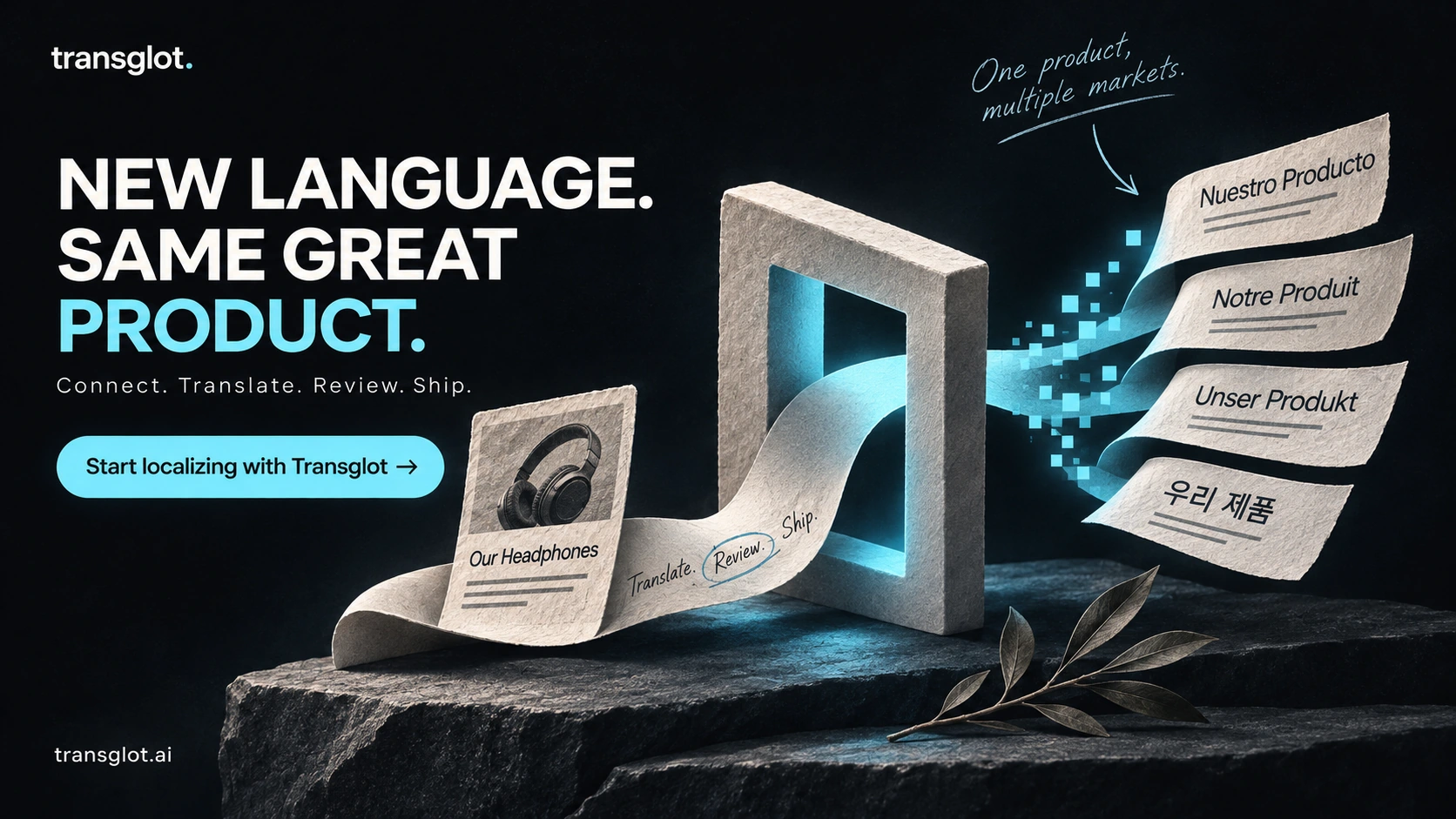
Conceptual editorial illustration · Start localizing with Transglot
Start localizing with Transglot.
Choose a process your business can keep running
AI translation software for business is most useful when it helps a customer journey stay understandable as the business changes.
Choose an API when programmable generation fits a process your team can operate. Choose a connected localization platform when changing source content, shared review and return delivery are central to the job. Use specialist expertise where the content requires it.
Transglot is a strong option to evaluate for ongoing repository and CMS localization, especially when the business wants a shared workflow with clear published entry pricing. Test the relevant connection, language quality and required plan on your own content.
Start with a journey customers need. Make it work. Keep it current. Then earn the right to add the next language.
Explore Transglot for your business.
Frequently asked questions
What is AI translation software for business?
It is software that uses AI to translate content a business needs for customers, employees or partners. Depending on the product, that can mean documents, website pages, application messages or content translated through an API. Some tools focus on generating the translation, while others also manage source changes, review and delivery.
Choose according to the complete job. If you need occasional proposals translated, document handling and specialist review can matter most. If your application changes every week, keeping languages synchronized becomes a central requirement. Define the audience, content source, destination and approval owner before selecting a tool. That makes the purchase easier to evaluate and gives the team a clear measure of success.
Is AI translation good enough for customer-facing content?
It can be useful for drafting customer-facing content, but acceptance depends on the language pair, subject, context and review process. A strong result on a product description does not establish that the same setup handles a short error message or an important purchasing condition equally well.
Run a representative pilot and define the errors that block publication. Have qualified reviewers inspect meaning and terminology, then test the rendered customer journey. Keep important commitments under appropriate human review. Also distinguish automatic technical checks from semantic judgment: preserving a variable does not prove that the sentence explains the correct action. The relevant question is whether your process consistently produces acceptable content for its intended use.
How is business translation different from localization?
Translation concerns the meaning expressed in another language. Localization concerns the surrounding experience for a particular locale, including conventions and product behavior that affect how people use it. A business can translate its interface while still presenting confusing dates, unsuitable currency formatting or a layout that does not accommodate the translated text.
Treat language work and product preparation as connected responsibilities. The translator needs context and terminology, while engineering needs to ensure the application can display and format content appropriately. Commercial teams also need to confirm what the business can actually offer in that market. A translated delivery promise must match the service available to the customer, regardless of how natural the wording sounds.
Should a small business buy a platform or use an API?
Use an API when your team wants programmable translation and has a clear plan for operating the surrounding process. That includes identifying changed content, preserving reviewed work, handling failures and delivering the correct version. An API can be an effective building block when those responsibilities already have owners.
A connected platform is worth evaluating when recurring source changes and collaboration are becoming difficult to manage manually. The subscription then buys more than draft generation: you are evaluating whether the workflow removes enough recurring work to justify it. For occasional documents, a simpler approach can be sufficient. Start with the actual workload and available engineering capacity rather than assuming that a custom integration is automatically cheaper.
Which language should we translate into first?
Start with evidence of a reachable audience. Existing enquiries, relevant traffic, sales conversations and support requests can help identify where language is creating friction. Combine that evidence with commercial readiness: payment, delivery, onboarding and support need to work for the market you choose.
Avoid selecting a language solely because it has many speakers. A smaller market with clear demand and a maintainable customer journey can provide a more useful first project. Name a language owner and reviewer before launch, and choose a contained scope that customers can complete. Measure the outcome and the maintenance effort before adding another language. The first launch should teach you how to operate the next one.
How much does AI translation software cost?
The total depends on the subscription or service fee, usage rules, target languages, review effort and work required to maintain the process. Some vendors meter characters, some words and some document-related operations. A headline allowance is difficult to compare until the workload is specified.
Request an estimate for the same content volume, update frequency and required controls across the options you are evaluating. Include setup separately from recurring costs, and measure reviewer and coordination time during the pilot. Treat any savings calculation as a model until its assumptions have been observed. A low generation price is useful, but it does not guarantee a lower total cost for approved content delivered to customers.
Can AI translate our technical or specialist terminology?
AI can draft specialist material, but it needs a controlled vocabulary and enough context to interpret the terms correctly. Give reviewers a glossary with definitions, approved equivalents and examples. Keep terminology changes owned so one person's preference does not quietly become the rule for every future project.
Use reviewers with the relevant subject knowledge, especially when an incorrect term changes an instruction or claim. Also improve ambiguous source copy before translation where possible. Repeated questions often indicate that the business has not clearly defined its own concept. A useful workflow turns those questions into better source descriptions and terminology guidance, rather than asking every translator to solve the same puzzle independently.
Is a free translation tool enough for company documents?
It depends on the document, intended use and the tool's terms. A simple reference translation of non-sensitive material has different requirements from a customer proposal, confidential internal document or specialist instruction. Check what content is permitted, how it is handled and which features the free offer includes.
Do not assume that a free interface provides the API access or workflow controls needed for an automated process. Also inspect the delivered formatting and have the right person check important meaning. Free access can be a useful way to explore a tool on suitable sample content. The production decision should reflect the business's actual review, data-handling and delivery requirements rather than the absence of a subscription price.
Will translating our website improve sales?
Translation can remove language friction, but it does not guarantee a sales increase. Customers also respond to product relevance, pricing, trust, payment availability and the quality of the overall experience. A translated landing page cannot compensate for a checkout the customer cannot complete or delivery that is unavailable in their market.
Choose a complete journey and define the outcome before launch. Inspect comparable traffic where possible, and account for other changes that affect conversion. Look at customer feedback alongside the numbers. A translation project can be valuable because it makes the product usable, even before there is enough traffic for a reliable commercial estimate. Report the evidence you have without turning a simple before-and-after change into proof of causation.
How can we start with Transglot?
Choose a contained product or website journey and inspect the connection your source system needs. Confirm the relevant plan, connector direction and approval controls, then test a complete cycle using representative content. Include a source change after the first translation so you can see how updates affect the work.
Assign a reviewer, supply terminology and context, and verify what arrives in the destination. Keep the first scope manageable enough to inspect thoroughly. The goal is to establish a process your team understands and can maintain. Once it works, expand according to demand and reviewer capacity. Explore Transglot and use its current documentation to check the exact requirements of your workflow.
Start with one journey your customers need.Explore Transglot ↗
Sources
Official product documentation, W3C guidance, the named GitHub report and WMT25 research were read for this guide. Product documentation was rechecked 5 November 2026. No live vendor benchmark was performed. Aster, the store and consultancy are fictional; calculators and acceptance exercises use hypothetical assumptions. Price snapshots and plan terms can change.
- transglot.ai · transglot.ai
- github.blog · octoverse-a-new-developer-joins-github-every-second-as-ai-leads-typescript-to-1
- www.w3.org · qa-i18n
- transglot.ai · developer
- www.deepl.com · developers
- docs.cloud.google.com · api-overview
- learn.microsoft.com · translator
- transglot.ai · editor
- github.com · using-the-languages-api.mdx
- docs.cloud.google.com · translate-documents
- cloud.google.com · pricing
- azure.microsoft.com · translator
- transglot.ai · glossary
- transglot.ai · quality
- aclanthology.org · 2025.wmt-1.22
- transglot.ai · pricing
- transglot.ai · security